Africa, Imagined

Africa. Continents yet to be conquered!

DSC01692_DxO

A whorl of images and impressions come to mind at the very utterance of the word: from Barbara Kingsolver’s The Poisonwood Bible, a jungle-like opulence of green fed by a muddy river, along the banks of which dwell heathens, in and mostly around their mud and thatch huts. “Wildest Africa”, a BBC documentary series, with its episodes on Lake Manyara, the Ngorogo Desert, the Rift Valley, and the famed Serengeti National Park. The dessicated dryness of Botswana, described by Norman Rush in his insufficiently-appreciated masterpiece, Mating. The Michael C. Rockefeller Wing at New York’s Metropolitan Museum of Art, named in honor of a Rockefeller who died too young and made African art his collecting passion. Or the contemporary artist El-Anatsui, whom I imagine walking the dirt-covered streets of Kumasi patiently collecting metal wrappers and bottle tops so that he can knit them into wave-like quilts in colorful reds, yellows, and oranges, evoking the bright robes wrapped around Maasi cattle and goat herding natives of Tanzania and Kenya.

DSC01695_DxO

Older images, too. Silly Ernest Hemingway strutting around Mount Kilimanjaro, rifle slung by his side. Maps imperially drawn and redrawn by distant colonists in dusty rooms. How much has changed? Of course, what could I possibly write about an entire continent, anyway; here, I offer observations only about this or that place that I’ve been. Points on a map. Points on a map becoming places, at least to me, to all of us.

In today’s world, perhaps in any world, it is impossible to travel to places new or unexplored without harboring preconceptions about the people, their health and the vitality of their economy, the look of their cities and the smell and dusty moments of their alleyways. Most of the time, these preconceptions keep our company unannounced and so by and large, we fail to notice them. Now that I’m in Africa, these subterranean vignettes, anecdotes, images and imagined artifacts are surfacing. Many of them, I discover, derive from my experience with one or another form of art.

And too often, I find myself thinking one version or another of the formulation, “X/Y/Z looks/is/isn’t different from what I’d thought it would look like/be/etc.” I try to guard against such reflexive musings, and when I do find myself thinking them, seek to quickly set them aside, as I am convinced that insights that do not originate in comparing or matching reality to expectations are in every way superior. As my social-scientifically-oriented spouse will repeatedly assert, of what relevance is what “I thought” to a sober, open-eyed account of what’s on the ground?

DSC01674_DxO

— Sarah, Arusha, Tanzania

The Human Factor

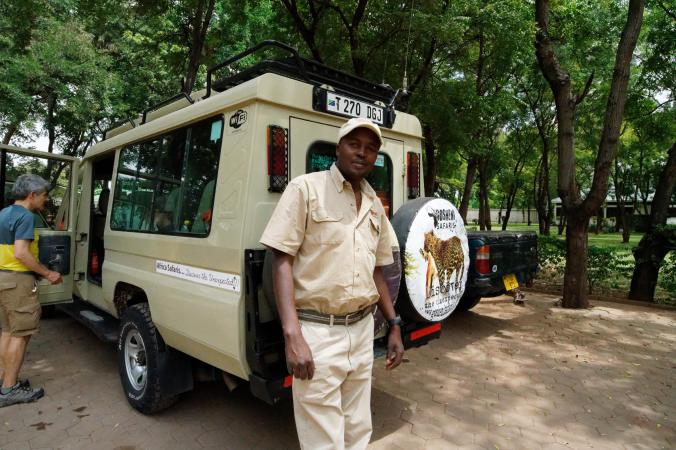
The transition from the hypermodernity of an airport as vast and efficient as Schiphol to the entropic arrival place, space, and pace of the diminutive airport of Kilimanjaro stands in for the contrast between the countries of northern Europe we visited and, at least so far, the countries of Africa on our schedule. We’ve come to Tanzania to go on safari, a term of ambivalence for me owing to its past, but which, moving with the linguistic times, I should and have reluctantly come to accept. Zadock greets us before we even say hello, with my name on a sign the moment we are released from the benign mob scene of passport control, where we, owing to foresight, endured much less hardship (warm waiting time) than the vast majority who had to first go through the super-mobbed visa-acquisition process. Whatever apprehensions we may have had that any of the many things that could go awry might do so, they dissipated into a sense of assurance with Zadock’s open and friendly face, excellent English, and sure air of competence and vigor. He, we learned, was to be our guide for the safari.

DSC01741_DxO

My first impression of Zadock has proven enduring, as the stream of information about him and from him coming our way has confirmed my and then our confidence in him. If anything, my initial impression, as fine as it was, undersold Zadock’s many fine qualities, as he is in every way an excellent driver, guide, and companion.

I start with Zadock because our time here began with him, and also for a more fundamental reason. He is with us for 8-10 hours a day, driving us, making continual decisions about where to go to see or to try to see these or those animals, informing us about the animals or trees and flora by offering us mini-lectures or simply answering our many questions; and developing an ongoing conversation with the full range of topics from soccer passions (in his and Gideon’s favorite league, the British Premier League, Zadock roots for Chelsea and Gideon for Liverpool) to politics, to family, to music, to wit of both kinds, to… well, the catalogue goes on and on. Zadock takes his profession seriously, and his craft as a vocation, as he is always learning by taking courses, reading books, and looking up whatever elicited information he doesn’t already know. We appreciate the many orders of magnitude by which he is enhancing our time in Tanzania, and the fine companionship he is providing us.

DSC00280_DxO

Zadock is as big a part of our Tanzania, and will be as memorable a part of it, as the animals and landscape. Our memories of experiencing this singular and extraordinary part of the world will be populated at almost their every moment with our memories of and interactions with Zadock. Along the way of our journey, we have met and seen many people, but so far only fleetingly. Zadock is the first person we have spent a great deal of time with, and gotten to know to the degree that we can think that we actually have at least a moderately good sense of him. Aside from liking Zadock immensely, we count our blessings that we got such a good guide and companion for this long week, and aside from counting our blessings that we did not end up with a mediocre (or worse) guide and companion, we like Zadock immensely. When we think about and talk about Tanzania years down the road, he will, with his by then astral presence, continue to add new benefit to our lives, as that is what fine and deserving memories do.

— Danny, Tanzania

Ghent!

I don’t have much of a sense, more than it not being a marquee or top ten destination, of how Ghent rates as a place for the traveling public. Certainly, for the non-traveling public, at least the American, Ghent cuts no figure whatsoever. We chose to situate our time in Belgium here because the guidance which Lonely Planet and various websites gives led us to conclude that it was the smartest move.

DSC01384_DxO.jpg

We had planned a day trip to Bruges, but ditched it in favor of savoring Ghent. We will touch down in Antwerp, as we did in The Hague, for a short look-see on the way back to Schiphol, where we will in three days leave Europe behind for now, and embark on one of the most anticipated segments of our trip of only anticipated to highly-anticipated parts: safari in the famed parks of Tanzania.

We have the sense that we are playing out the string for these final few days in comfortable Europe, a feeling contributed to today by the steady rain and the grey that is its bedmate. We were out for a few midday hours tramping about the puddles that form in the troughs between the cobblestones which pave many of the streets, yet kept dry by our miraculously supple and light rain shells courtesy (for a fee) of Patagonia. But rain is still rain. Our journey took us to the recently completed city library by the most recent Pritzker Prize winners. Whatever its acclaim, it’s either a dud or just fine. Evolutionary Mies or softened up Mies or watered down Mies – take your pick. It tries to cut a figure in the cityscape with pizzazz that will elicit a wow. But it fails, even more in the steel-flesh than it does as a photo, as it seems to have the air of cool and edginess without actually being cool or edgy. A bad and self-undermining combo — ask any teenager. The interior is at best clean and uninteresting, and at worse, a bit dehumanizing (read Sarah’s current GREAT book, Welcome to Your World: How the Built Environment Shapes Our Lives). This now makes signature buildings of two Pritzker Prize winners in a row extremely disappointing.

(Disclosure and disclaimer: My amateur pronouncements on architecture (and art) are (for better or worse) mine alone and should not be construed to express or reflect Sarah’s (or Gideon’s!) views in any way, unless I explicitly indicate that they do. Although I am and always will be a diligent student of Sarah’s, I often do strike out in my own direction.)

As with many failures and disappointments and fallings-short (how many things don’t fall short in some way?), the library led to a productive discussion, which continued over lunch, about how prizes are not to be taken so seriously (or seriously at all), as the record of awards for the Pritzker, the Nobel, the Pulitzer and many others show. Gideon was amazed by the list of Nobel literature winners, both who won (a who’s who of never-knowns and already-forgottens) and who by their absence were demonstrably never deemed worthy, including such argument clinchers as Tolstoy, Proust, and Joyce. The Peace Prize is rightly a standing joke: Kissinger, Arafat!!, and Obama. Politics of, candidates’ friendships with, and fads too strong to resist among the people who in a given year are the jury members have plenty to do with such awards. This state of affairs is hardly the end of the world, but it does mean that we should not confer the mantle of greatness on prize winners just because they won. Back to Tolstoy, Proust, and Joyce. Throw in Bob Dylan and ask the Sesame Street question: Which of these things is not like the other? Chances are you and the Nobel committee agree – but for different reasons. Anyway, our lunchtime discussion about the library and prizes was illuminating (especially for amazed Gideon), and fun was had all around.

The next, our final full, day in Ghent was perfect weather, and, lo and behold, the sense of playing out the string dissipated.

DSC01359_DxO.jpg

Gideon, who had spent the night with his friend Mike in Brussels, returned at 3:30 in the afternoon. Until then, Sarah and I spent the day walking Ghent, talking about and analyzing Ghent, photographing Ghent (that’s Sarah), and marveling at Ghent, both in the super-historic center and the merely historic and partly modern near-center.

DSC01431_DxO.jpg

There is much to say about Ghent, which Sarah can do with far greater perspicacity and literary verve. I gather she intends to do so in an extended form somewhere down the line.

After Gideon’s return, we congregated and caught up in our Airbnb, another lovely apartment (in a building from 1723 in the heart of the city center) which contributed substantially to our sense of wellness in Ghent.

Evening now approaches. We’ll get dinner and do a little packing-triage of things we’ve discovered we don’t need as we head to our stops in Africa.

— Danny, posted in Tanzania, 14 August 2017

Traveling in the Present

Traveling, denotatively, involves the physical act of moving one’s person from this or (as in our case) a succession of places to yet other places. Connotatively, traveling – unless it’s for business or to visit family – also suggests that wherever one lands is in one way or another unfamiliar, and that the journey is undertaken with the explicit intent of discovering unknown sights and sites, human settlements, topographical lands and oceans, textures, flavors, smells, sounds. Whatever “experiencing” a different culture or place means, traveling is customarily the way in which one endeavors to do it.

Contemporary psychologists advise spending discretionary resources on purchasing such constructed moments rather than on goods, owing to their long-term bang-for-the-buck superiority. A new necklace will always become an old necklace. But a trip! It can ignite months of anticipatory reverie. Then it will unfold, however it does, at as slow a pace as everyday life. Then, once completed, its moments and its entirety will be repeatedly savored retrospectively, the mind consolidating the impressions and recounting the narratives into mental vignettes, little polished crystals that get shoved into that overstuffed storehouse, memory.

Traveling creates especially powerful, resonant experiences precisely because whatever ordinary life is, traveling is different. Professional obligations, most of them, catapult into some distant galaxy. Schedules are kept, schedules are disrupted. Tidiness becomes irrelevant; no matter how carefully you lay things into dresser drawers at your temporary abode or pack them up again when the itinerary dictates moving on, you’re just going to be pulling stuff out of your suitcase again. Everything feels new. So much is new: the shape of the illuminated red figures on crosswalk signals, the color of cobblestones, clothing styles (floral patterns, I have discovered, are big in the Low Countries, both for frumpy matrons and the chic set), the clean sky in the late afternoon light.

A group of literary theorists in Russia at the beginning of the 20th century developed a uniquely salient concept to describe the experience of this-and-there-ness, or of this-and-there-and-absolutely-nothing-and-nowhere-else-ness, that a work of art can inspire: defamiliarization. You’re reading a novel, or scanning a painting, or watching a performance, or listening to a piece of music, and it all seems more or less familiar, observations or brushstrokes or phrases or movements you’ve borne witness to before, until suddenly — it’s not. It’s strange. It’s new.

DSC01178_DxO_DxO

Defamiliarization, or estrangement, is a concept I pondered and revisited in those hazy, unreal weeks after delivering Veronica, my first child. Gently I would slide her tiny body into the Snuggie and go for summer walks. Once I stopped on a bridge to show her the train tracks running below. Now, I wondered, what could an infant possibly make of this? To this creature, nothing was familiar, all was strange.

Traveling, I am learning, differs from traveling well. Traveling well, or skillfully, requires many qualities one finds in a robust individual: determination, flexibility, humor, resilience, energy, a collaborative orientation along with partners with whom collaboration is both possible and gratifying. The last exigency of traveling well: living in the present or, to use the now-clichéd phrase coined by the Buddhist writers with whom I mentally hang out on occasion, being in the moment.

DSC01342_DxO

To receive what travel can offer necessitates making oneself as open as a sieve, letting every facet of every fleeting experience run through that self clean. Guard against preconceptions. Watch. Interpretations, later. Moments well used are moments spent scanning, thinking, scanning, listening, inhaling, smelling, wondering.

One thing I’ve discovered three-and-one-half-weeks into a yearlong trip around the world: life doesn’t stop just because travel starts. Surprise. On some days, I open up more than others. Ruminations of a fugitive sort, wondering how this book is faring or why that author chose to confess what he did, idle musings about a friend’s (or my son’s) state of mind, fantasies of other lives and others’ lives, all these, and more, wrests me from my – our – appointed task.

It’s coming easier. Belgium, where I have never been, seems a turning point of sorts, probably the first of many (I write this on the place from Amsterdam to Arusha). Why does a Flemish city as small as Ghent, our post-Amsterdam destination, have so many churches concentrated in such a small central area? (In the early middle ages, Ghent’s cup runneth over, and it became the third largest city in Europe, bested only by Paris and Constantinople.) Does Gouda really smell different in Amsterdam than in New York? Why is it that in Flanders gabled roofs are stepped, called crow-stepped roofs? (Easier to climb up and down to repair, I discovered.) And what’s the difference between a Dutch gable and a Flemish gable? (Dutch ones are curved.)

How many people live in Ghent anyway? And what is it about that city that has completely stolen my heart?

— Sarah, written in Ghent, posted 12 August 2017

A Lineup of Greats

On August 5, we all rose early, packed up the overnight strays, said goodbye to the apartment we so enjoyed as part of our successful stay in Amsterdam, and headed in our rental car to Schiphol, where we dropped Veronica off for her return to New York. We were delighted that Veronica found Amsterdam interesting and to her liking, its small scale, walkability, and undeniable charm making it, among other things, manageable for Veronica, who does not thrive on overstimulation. This week with us was… a week with us on our extended tour, and also a vacation for her from summertime work in New York. Fortunately, being separated by an ocean is not nearly as distant as it was even a decade ago. We are in daily text, email, and voice contact with Veronica – on a par with how much we are when we are all in New York, so whatever cliché or piece of wisdom used to be able to be trotted out about the effects of distance on relationships, they are radically undermined by the digital revolution.

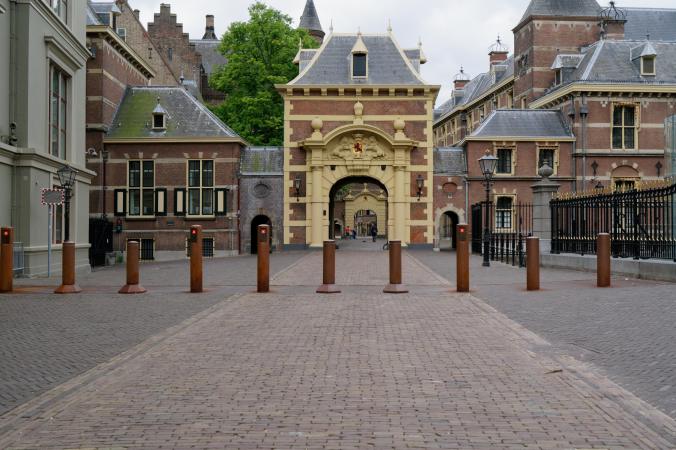
We continued from Schiphol to The Hague to see the center of the city

DSC01328_DxO

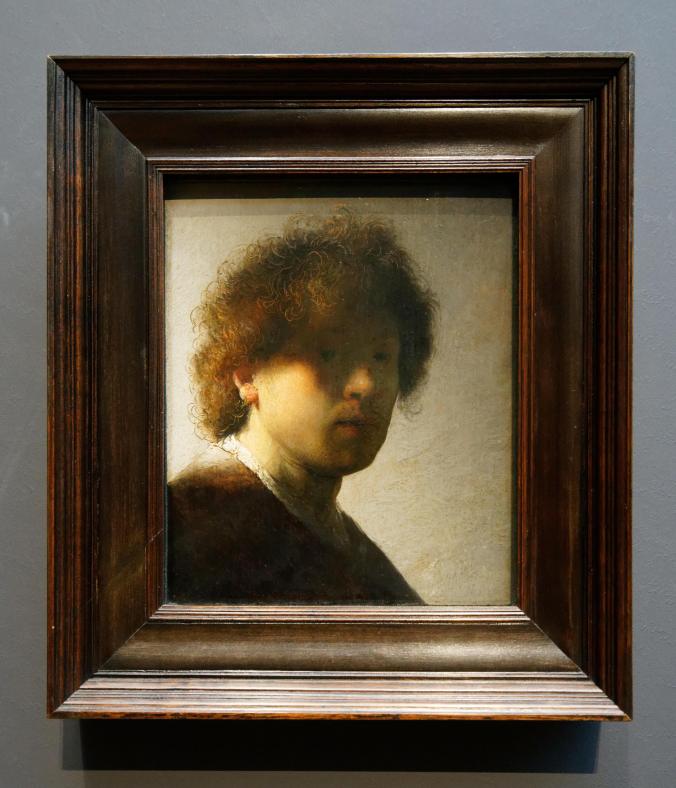
and two museums, the Maurits House, containing in its sumptuous galleries great Rembrandts,

DSC01329_DxO

and Vermeers,

DSC01338_DxO

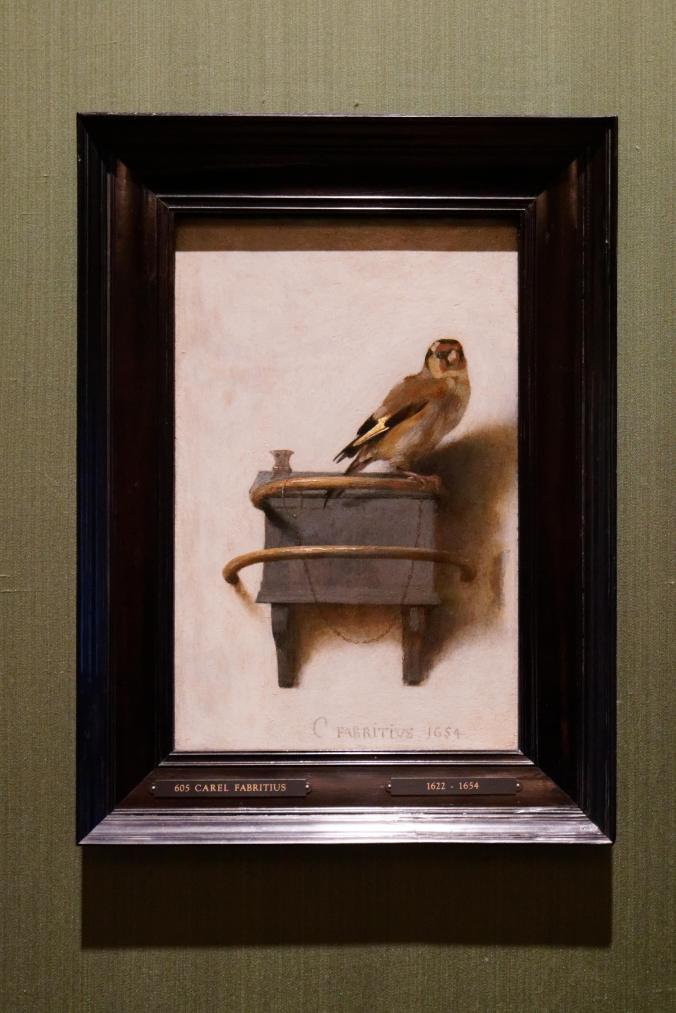
and, of particular literary importance though visual disappointment to Gideon, The Goldfinch;

DSC01336_DxO

and the Gemeentemuseum, a stunning (in my experience) singular building designed by Hendrik Berlage in the early 1930s, which houses the world’s largest collection of Mondrians to architecture and art’s mutual enhancement. The museum, which I (perhaps understandably) had remembered as being a Mondrian museum (it’s not), offered us the largest display of his works and treatment of his life and influences it has ever put on. It’s the largest because it’s everything the museum has, its “entire 300-strong collection.” Mondrian’s signature style is, of course, on display, as are his earlier abstract pieces of more color and non-rightangled-linearity, many of which are as captivating and artistically (though not art-historically) worthy as all his boogie-woogies and their sparer ilk. Most interesting for Sarah and me was the clear progression that can be discerned – it’s pretty obvious – on how Piet Mondrian became Mondrian or, put differently, how he, through experimentation and evolution, developed his mature style. This developmental theme, as with so much of the visual and constructive arts, I clued into thanks to Sarah, who investigated it as a central problematic in her great book Louis Kahn’s Situated Modernism. (Modest Sarah might like to stop me from writing the plain truth about this GREAT book, but as we have, easily and naturally, agreed that each of us should have a free – always respectful – hand in our respective entries, I incontestably respectfully will insist on having my say.) Creativity is an endlessly fascinating theme. That is recognized. The development of creativity, a creative dimension in its own right, is of equal interest even though it appears to be a tertiary theme. This is one of those more later moments.

The Hague was a nice on-the-road-to-Ghent follow-up to Amsterdam,

DSC01310_DxO

both in providing a quick comparative insight into Dutch urbanism and some critical leverage on what we had come to so relish about Amsterdam, and in its Flemish art and architecture, in which graceful old is repeatedly complemented by well-designed new, as we witnessed again with the underground contemporary entrance to the otherwise undisturbed original villa of the Maurits House museum. On the way out of The Hague, we stopped in its outskirts at a dedicated gluten-free bakery, owing its situatedness to a Welsh baker with Celiac having married a Dutchman. We recommend the Welshstone Bakery as one of the two best such bakeries (By the Way in New York is the other) we have yet found.
Amsterdam for espresso, The Hague for gluten-free bread and pastries. What delicacies are next?

— Danny, a few days ago in Ghent, 10 August 2017

Another Kind of Archipelago

Amsterdam, famous for its canals, charming brick, windowed, and gabled row houses each of individual and often distinctive design, and ever more, and ever more unfortunately, for its coffee shops — the local language-and-concept-degrading moniker for legalized marijuana dens — should be better known for what remains a non-degraded, indeed exalted moniker and what it describes: cafés.

cafe amsterdam

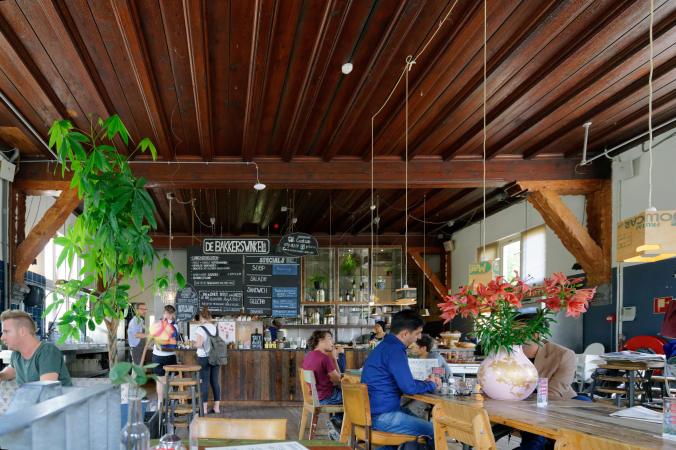
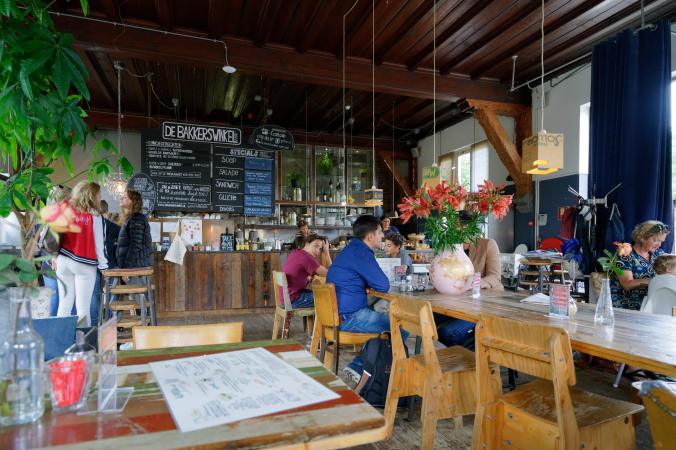
Cafés dot the city in a two-dimensional archipelago which provides far more coverage, flow, and motor power than do its deservedly attention-grabbing canals. Starbucks exists as a tenth-rate player in the genteel and gentle café competition to fuel the brains, minds, reading and writing lives, and social relations of Amsterdamers and of their abundant on-the-slow-go visitors. Local chains and (what appears to be) endless one-off establishments welcome all comers in the best café way of fine elixir, on-the-(seemingly)-whole wholesome and inexpensive food options, sumptuous and varied (though not wholesome) deserts and snacks, and an atmosphere of leisureliness. A notable additional feature — especially to the hardened New Yorker habituated to crammed tables and the substandard, undesigned interiors of things seemingly just thrown together as good enough even though this is an injurious fiction as most fictions are — is the spaciousness and thoughtful design and excellent materials, especially woods of various kinds and cuts, which café after café offers its temporary denizens.

DSC01257_DxO

Entering a café here need not be just to fill a need or afford a function, with the cost being to jostle for a spot in line, jockey for some decent natural or unnatural illumination, or fend off, with earbuds or an act of will, the din.

DSC01103_DxO

In Amsterdam, it is to enter a place to which evident thought has been given in creating a commodious environment, a place of grace.

I exaggerate not what I have seen, and overstate the matter not even though my sampling technique has been a bit too haphazard and pecunious to be called social science. During this week here walking and walking the streets of Amsterdam, passing time in a substantial number of these necessary and discretionary islands of repose and humanizing offerings, and willfully examining many others both in their presentational sidewalk portions and in their beckoning interiors, I have been struck repeatedly by the qualities I mention.

cafe amsterdam2

Sarah earlier used the multivalent and (robbed of its religious context and intent) generally underused word grace to describe some aspect of Oslo. Well, I echo (me-too!) its usage, insisting on the non-hyperbolic seeming hyperbole of conferring in a secular sense the appellation place of grace to the Amsterdam café archipelago as an ensemble, and to café after café. In New York – a high-bar standard for many fine things – I hardly ever want to enter let along seek to find a café, even though I love passing time with friends and (speaking of loving to) with loved ones, especially Sarah. Here, I hanker to go out with Sarah into this gracious and ennobling public realm, and spend time reading and (mainly) writing, except when we are talking or, as I prefer to think about it conversing (I am just finishing a book on conversation). If I haven’t yet said to Sarah (I will when she reads this), one of the attractions of spending more time in Amsterdam is this stunningly underrated (Gideon’s notion again) gracious public realm. By the way, but hardly by the way, the espresso (my drink of choice) and according to Sarah the cappuccino (her go-to hot beverage) is the best of any country I have visited. Almost uniformly strong and coffee-tasty, without being too acidic or bitter, I have had exemplary double-cup after double-cup.

It has occurred to me that whatever interest in or emotions about the built environment, the natural environment, people, things, or activities we might excite or satisfy with our composition here of sentences and photographs, for those of you wanting to vicariously sample culinary adventures, we, unlike so many others (I suspect the overwhelming majority), are not foodies, do not organize our travels writ large let alone our days writ very small around cuisine, and will therefore offer little besides gluten-free hunts(Gideon has Celiac) and a perfect cup of double espresso for your voyeuristic or reading pleasure. Sorry, but obviously not that sorry.

The installment above was, when I began it, intended as brief preamble, but as with many things existing in the mind’s eye or less elaborately with just a starting-impulse of an intention, it emerged and developed more insistently, to be and become a thing in itself. I was expecting to write an extended account of a lovely (and for me thought-inspiring) café Sarah and I lunched in that has repurposed a building which had been part of an erstwhile factory complex, which, redeveloped, is now part of a recreational area which features an inspiring contemporary park Cultuurpark Westergasfabriek by Kathryn Gustafson. (We told Gideon about the park, which he, independent and enterprising, subsequently biked to and had a picnic, of the cheeses he had bought, sitting in the clearing in the midst of the seas of grasses blowing to-and-fro in the insistent wind.)

DSC01285_DxO

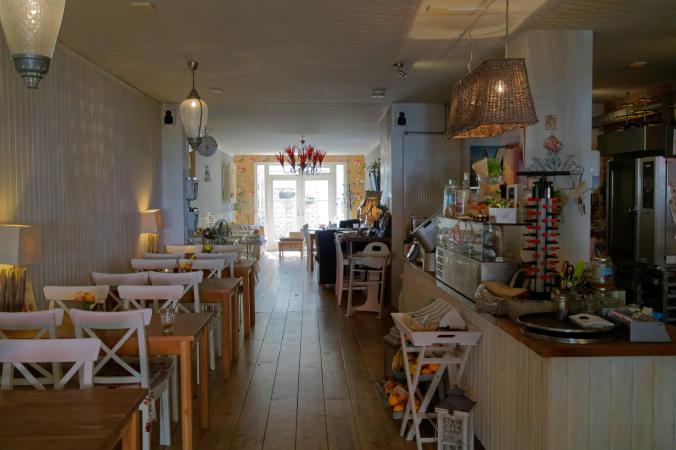
As things turned out, the planned account of this café will have to wait, perhaps forever. Here are, at least, a couple of photos.

DSC01263_DxO


DSC01256_DxO

— Danny, 9 August 2017, written in Amsterdam, posted in Ghent


Goldfinches in Amsterdam

A recent article compared Venice to DisneyLand, reporting that now that its 60,000+ permanent residents receive over 28 million visitors per year, it lacks a complex economy and indeed is well past the point of functioning as an authentic urban agglomeration, having devolved instead into swarms of tourists and selfie sticks buzzing canalside, gaggles of gapers tottering on the cobblestones of a disintegrating city. Crumbling palazzi, pigeon-infested public squares.

Amsterdam, the last time we were here, felt similar.
DSC01108_DxO

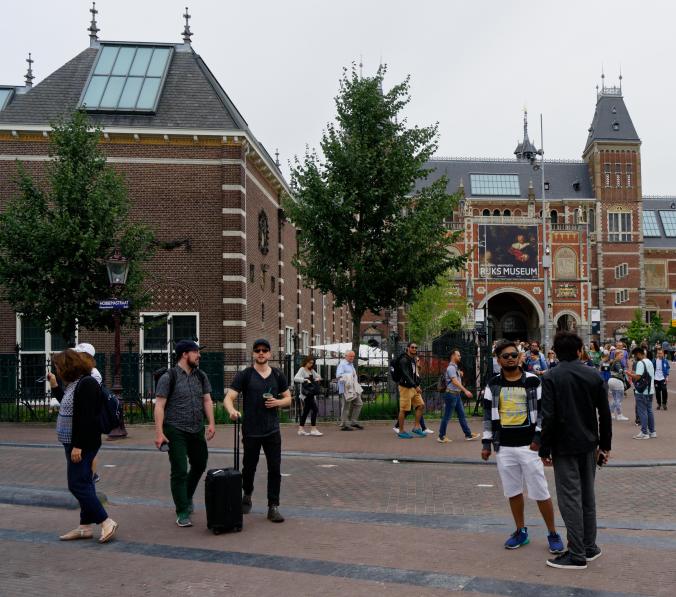
It was spring; Danny was speaking at a conference on human rights or their violent abrogation. Our flat was near the Rijksmuseum and, memorably, we attended a performance in the Concert Gebouw, across from the now-much-spiffed-up Museum Park.

That visit antedated the Stedlijk Museum’s extremely ill-advised, “Who-could-possibly-come-up-with-that?” And once they had, “How-could-any-client-go-for-it?” giant bath tub of an addition.
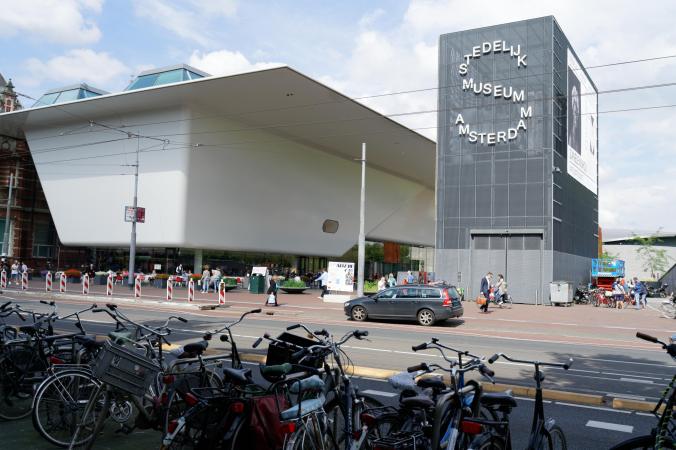
DSC01152_DxO

One moment yesterday felt the same: as Veronica and I were gathering our belongings to leave an outdoor café near the Oeust Kirche, three people slammed into me in succession (none of them pickpockets), and I nearly plowed into a human-sized Mickey Mouse. Or Constantin Huyghens. Whatever. Partly it’s crowds, but perhaps too partly it’s my age: my sister, seven years my senior, recounts that once she let her hair go white she became nearly invisible in public places: waiters ignored her, customer service assistants, probably without even realizing it, bypassed her for the next person in line, smiling their may-I-help-yous right past her.

This time here we are staying a bit outside the Centrum, in a surprisingly reasonably-priced townhouse on a canal near the Vondelpark, on a street named after a Dutch poet-nationalist, Jacob von Lennenskade.
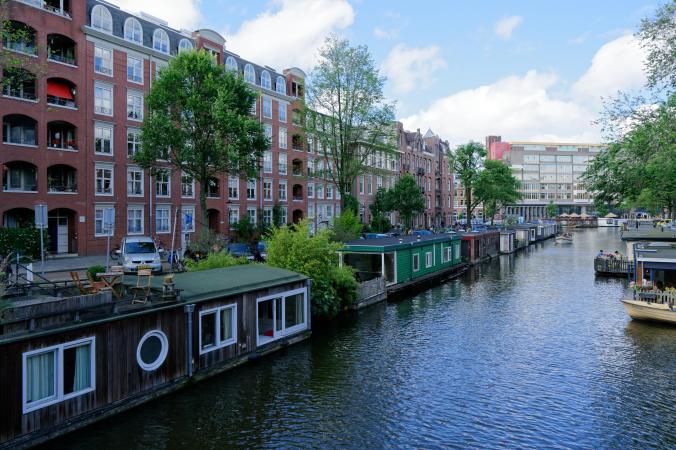
DSC01105_DxO.jpgIt’s a townhouse-and-houseboat-filled residential neighborhood (supermarkets, haircutting salons, the occasional “lifestyle” store), well-to-do to be sure, although not much here seems pricey after the out-of-this-world sums charged for power bars and toilet paper throughout Norway.

In unexpected ways, Amsterdam comes as a relief.
DSC01247_DxO

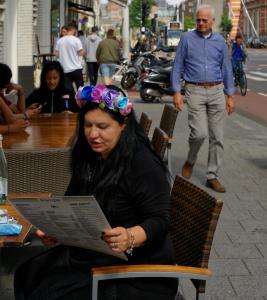
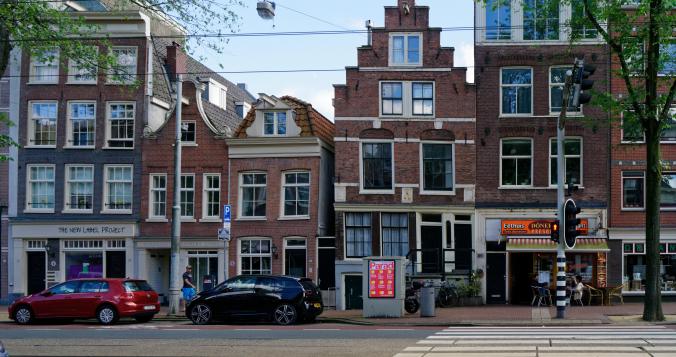
Miens are not overwhelmingly blue-eyed and framed with white-blonde or blonde blonde or reddish blonde or red hair.  DSC01153_DxOSome of the passersby we encounter on the sidewalks are even shorter than we are. (Tourists, probably.) Populating our neighborhood is an Indonesian vegan retauranteur who emigrated decades ago from the then-Dutch colonies; pitch-skin-black immigrants from Africa, black and brown refugees from various war-wracked, genocidal regions of this troubled world. Amsterdam feels New York-ish socially, then, without being at all like New York in most ways. Its vertically squeezed, low-scale, occasionally heaving-to townhouses insist:
 

DSC01106_DxO.jpg

This city is for walking (and biking). Drive uncomfortably, and at your peril. Later we learned from a cabbie that the municipality charges 130 euros per month just to permit taxis to drive downtown.

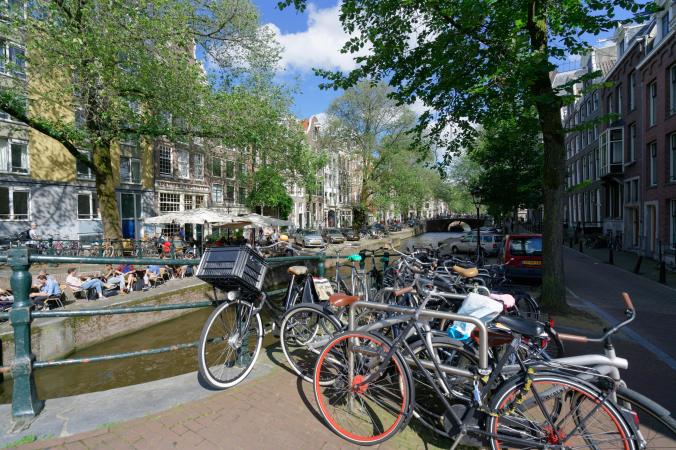
If wild Norway was all deep, black-green fjords, one-lane highways and desolate expanses of rock-strewn shorelines and pine-covered mountains, here in the Netherlands, every square inch of land has been fought for, conquered, and tamed. The environment – all of it’s a built environment – gives off the sense of being optimally planned for human use. The way the Dutch manage urban traffic crystalizes their approach to the design of nearly everything: most larger urban streets facilitate the flow of six forms of locomotion: pedestrians, trams, buses, bicycles, motor scooters, and cars. And the occasional line of Segueys, hovering unevenly at street corners.

DSC01108_DxOPedestrians crossing a street wait at a different crosswalk than cyclists do. Streams of cyclists pedal by at all times of day, some with one or two little blonde children perched unsteadily atop, one set into a contraption affixed to the handlebars, the other behind; bypassing these pseudo-juggernauts are men in skinny suits and ties and fashionably clad women in stilettos, delicately holding down the flaps of their skirts; all pedaling by in the morning rain.

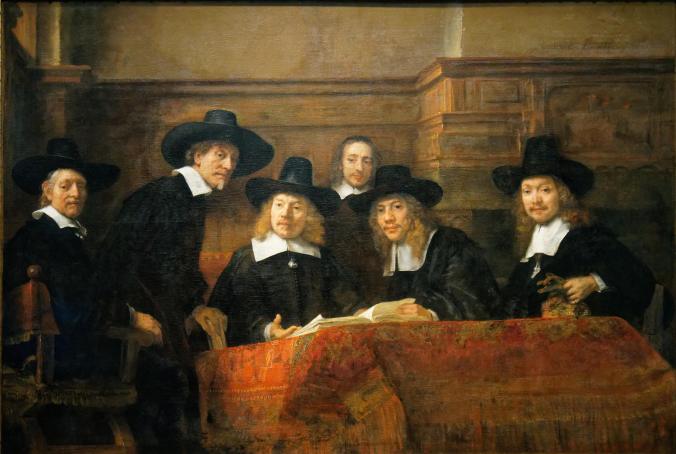
Ever since I first landed in Schiphol twenty-two years ago, pregnant with Veronica and desperate to flee my increasingly-lunatic and violent spouse (now gone), I have conceived of the Netherlands as a kind of utopia, and called it the Land of Good Design – but really, it’s the Land of All Good Things. Unbelievable art.
DSC01169_DxO

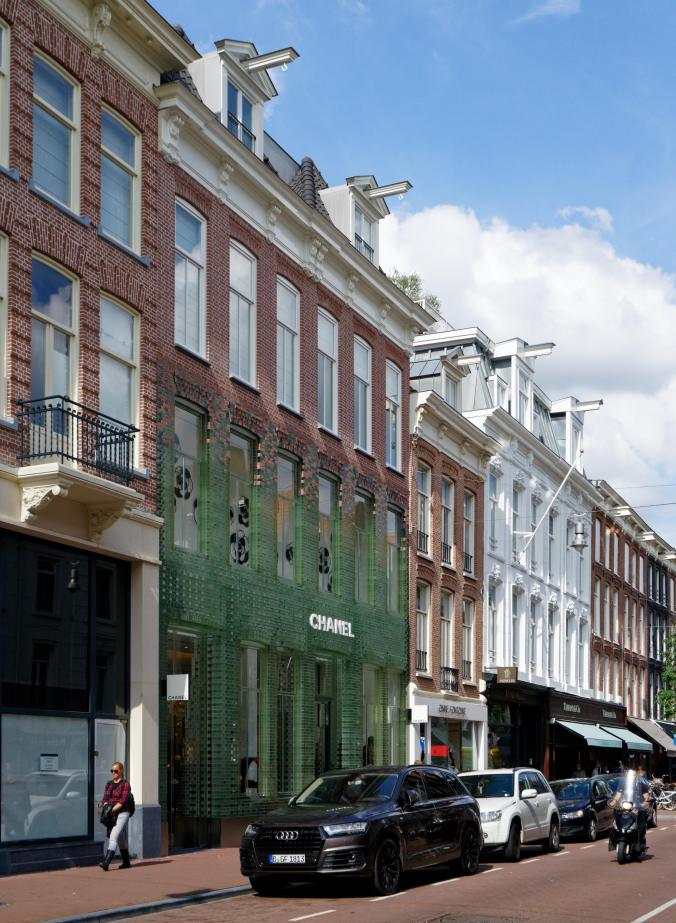
Sensible health care, evenly distributed. Well-considered, carefully constructed and maintained buildings — and the occasional ill-considered, but still carefully constructed one, as the Chanel shop below, where glass brick and brick weave together.
DSC01154_DxO

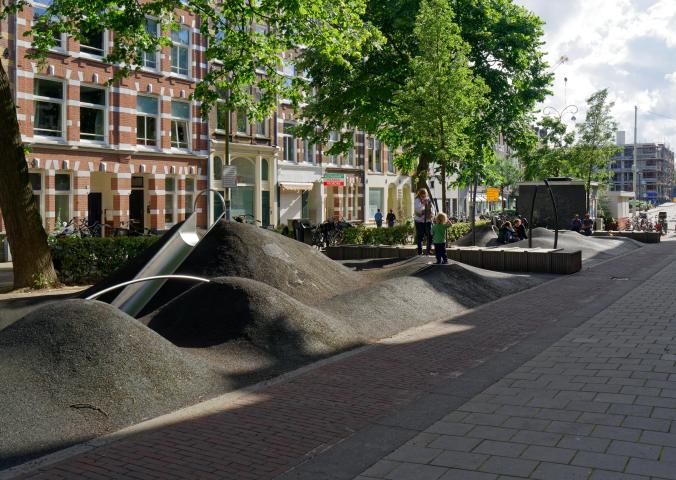
Every opportunity for memorable public space grabbed.
DSC01129_DxODSC01149_DxO

DSC01226_DxO

Etc. I know, I know: tongue firmly in cheek. Netherlands has problems too. Just ask Rineke Dijstra, or Marlene Dumas.

Still, when my first marriage was rapidly disintegrating, my adored father was literally dying, and a child tenaciously growing within me, the Netherlands offered itself to me as a land of respite. I’d come to do what I knew how to do, no matter what: work. To see, photograph, and research postwar buildings by architects loosely affiliated with an international group of self-proclaimed renegades, Team 10 — and to put myself back inside myself. And I loved it. Even the ordinary warehouses are well-maintained, cleanly detailed, I remember thinking, like crisp ironed shirts just back from the dry cleaners.

I feel as comfortable here as if I were in New York City; I’m sure there would be cultural frisson were I to live here full-time, but as the transients that we currently are, it’s difficult to tell where those moments would come from, or when they would occur. Occasionally, as I walk around the oldest part of the city, those torrid scenes in Donna Tartt’s The Goldfinch from Theo’s weeks in Amsterdam–

DSC01127_DxO

when Theo was strung out and holed up in some hotel, terrified, feet more mired in some dank, hallucinatory underworld than grounded on this one — waft through my mind. But then the cool summer sunshine burns such disturbed thoughts away.

DSC01262_DxO

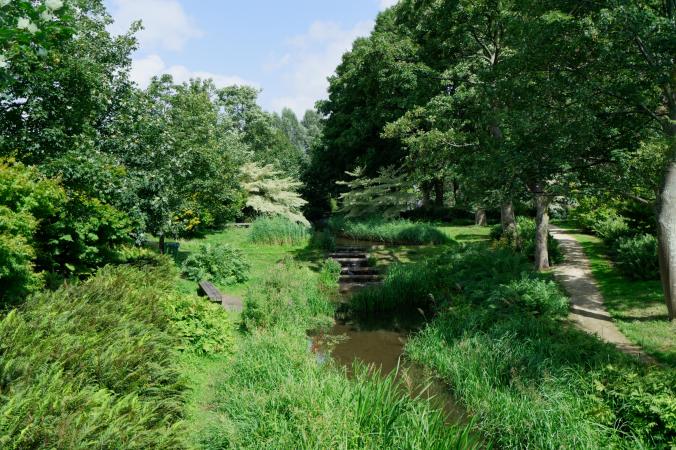
Kathryn Gustafson’s Cultuurpaark Westergasfabriek, with its birds flying high and grasses hissing in the winds, was a special treat.
DSC01290_DxO

— Sarah, written in Amsterdam 4 August 2017, posted in Ghent
Amsterdam

Veronica has joined us.

DSC01122_DxO

In coordinated flights along two vectors, we intersected almost perfectly temporally and spatially – thus, along the (by now) four classical dimensions — landing us within fifteen minutes (that’s a temporal blink of the eye) within a few hundred yards (a spatial hop) of one another in the space-time continuum known as Schiphol Airport on July 29, a little after 11 AM.

Among the many things that the twenty-first century has us taking for granted is the ease with which we move over vast spaces (planes), with stunning surety (schedules), and with amazingly easy coordination (the web). Sarah commented to us a few days earlier during our six-hour walk from Myrdal to Flam that completing such a slow, one-foot-in-front-of-the-other sojourn reminds us, and more conveys, how arduous and time-consuming moving from place to place has been for most of human history.

DSC00928_DxO.jpg

Sarah, Gideon, and I know that for many reasons we are fortunate – we know it every waking hour – and are also historically fortunate to be able to undertake our global venture. One additional reason that is germane here is we do so in an age when Veronica can easily hop on a plane in New York and with stunning precision land within easily measurable feet and minutes from us in Amsterdam.

In an instant, our family of four is reunited, is whole again, though it turns out, only fleetingly for the first couple of Amsterdam-days because Gideon’s good friend Mike from last summer’s Madrid program has come to Amsterdam for the weekend, so Gideon and he, late-teenagers that they are, have intensive one-on-one life-experience to share. That’s okay in a way, because Veronica, who is twenty-one, and we have much to catch up on and discuss as well, even though we saw her but a seeming blink of an eye of a fortnight ago.

We all (including Gideon and Mike on their own) spend the first few days doing what central Amsterdam invites visitors to do with such grace. To walk and walk and walk. I’ve never been in another city which so tempts and rewards (a rare enough combination) human ambulation.

DSC01161_DxO

Some might say Venice, the archetypical canal city does, but for various reasons — including it is hardly a city or, being a relic as theme park, it is hardly a real place — it doesn’t come close. London and Paris and Tokyo and Barcelona (and Gideon’s beloved Madrid), oh yes, New York, offer their own significant ambulatory rewards, but, again, for many reasons, including their vastness, they rise not to the same walk-about level as our Dutch champion does.

DSC01106_DxO

Of course, I haven’t been everywhere, so a city or two or three unvisited by me might yet capture my anointing-fancy. But no matter, or the existence of such inviting urbanity would be stupendous and a future treat to behold without it altering Amsterdam’s distinctive quality compared to so many other cities I love to walk around – I do, by the way, love to walk, and as with my other loves I do my best to keep as narrow as possible the gap between precept and practice.

I realize that my characterization of Amsterdam, tailing off without further elucidation, stands a bit totteringly as a tease. I may make good on its promise, and straighten its as yet unexplained posture, with my next post, but as there are so many things and themes to write about (the notes I jot down are already voluminous) perhaps some other topics will tempt and capture my compositional fancy and, if so, I hope will (that rarity again) reward yours.

— Danny, 6 August 2017, posted from Ghent

The Opening Arc

We’re on the KLM flight to Amsterdam, where in Schiphol we will rendezvous with Veronica. In sum, Norway has been a splendid beginning to our journey. A bit otherworldy in Lofoten; deeply affecting and unforgettable landscapes there, in the Sognafjord region, and on the drive onto Oslo; the opportunity to get our feet wet (wetter than we expected) as they, dry as can be, helped us scale, and scramble, and hike, and walk up and down slopes of unexpected difficulty and expected though still startling beauty;

DSC00399_DxO

cities and towns of a well-put-together country,

DSC00986_DxO

which, together with the universality of English, made our time negotiating a foreign land easy and stress-free; and two cities, though not spectacular, containing charm and enough urban offerings to occupy us engagingly for the short stays we allotted them. As a combination of highlights and ease, of newness and distinctiveness, Norway has been a sure winner as a place to start. Sarah and I have already accustomed ourselves to an existence of living abroad and underway. Gideon is a bit less settled, as the reality of a relatively kid-poor day-to-day requires adjustment. Yet spending so much time together, just together, in the countryside afforded bonded-us the time to bond even more in a right manner — an ubuntu-cultivating-practice which the Celtics pursued one year with a preseason stretch in Rome, setting themselves up for their successful championship run.

Norway is interesting (and fortunate) in other ways we should at least flag. Greatly owing to North Sea oil, as well as its people’s own human and social capital, it is among the world’s very wealthiest countries, producing a per capita income around twenty percent higher than the US and forty percent higher than Sweden. Yes, Sweden. This impressive wealth combines with broad income equality (its Gini coefficient is one of the lowest in the OECD), and enormous attention to public infrastructure, places, spaces, and goods. Rural areas and structures, notoriously poor around the world, are also sumptuous.

DSC00871_DxO

Roads (and gads of tunnels) are superbly designed and maintained. (We drove through the world’s longest car tunnel – 15.2 miles! – four times. We had not even known about it when we first came upon it in its rural area, and saw the sign announcing its 24 km. Imagine our momentary surprise.) Cars, in our two weeks of looking, are entirely dent and blemish free. Parks abound. Even the trees in the countryside have gotten on the program.

DSC00643_DxO

Materials used in the built environment are of immensely high quality, with textures that draw and excite the eye, mind, and body.

DSC00987_DxO

There is much to admire and consider about Norway, which even a cursory two-week visit such as ours should suggest to just about anyone, including and, especially during this era of mean politics and policymaking, to Americans.

After our mostly landscape oriented time in Norway, we have scheduled a couple of weeks of heavy-duty art, architecture, and urbanity in Netherlands and Belgium. This portion of our travels is not a change of pace insofar as these two countries also have extremely well-put-together societies (ignoring, Belgium’s schizophrenic ethnic composition and politics), yet it is a change of pace in the activities which will form the core of our stay.

We try to live focusing on the present, on the place we currently inhabit and the activity we undertake, maximizing the present’s potential. Nevertheless, on a journey which, in demanding so much planning, has compelled a great deal of forethought and prospective investigation, and, especially, with so many lustrous places ahead, it takes effort not to look down the road, especially, it seems, for Gideon when attaining and straining for a good vantage point directed at the geographically distant but temporally around-the-corner Serengeti.

DSC00797_DxO

–Danny, written July 29-30, posted in Amsterdam 1 August 2017