Writing about South Africa could consume a whole book. In light of what else South Africa has consumed, that’s no surprise, and that book would hardly constitute a footnote. In a sense, that’s true about whatever we write of everywhere we’ve been or will go, making South Africa no different. But South Africa stands out nonetheless, not in the trivial sense that all countries are singular along any number of dimensions, but because it is fundamentally different – and its marks of heart-wrenching distinction are palpable with nearly every step and in virtually every waking moment.
I do not intend to write the treatise South Africa warrants, merely to note elements, just kernels of them, which arise in the course of where my writing takes me and you. Yet one eloquent fact can help justify my opening, and set the stage for more. Of the 149 countries listed by Gini Coefficient in the CIA Factbook, South Africa has the second highest – meaning second greatest degree of economic inequality – exceeded only by the poor country it entirely surrounds and dominates, Lesotho. The most recent census (2011) revealed that the household income of whites is SIX TIMES that of blacks. (In the US, we rightly decry a white-black income gap where white households on average earn 60% more than black ones. In South Africa the figure is 500%.)
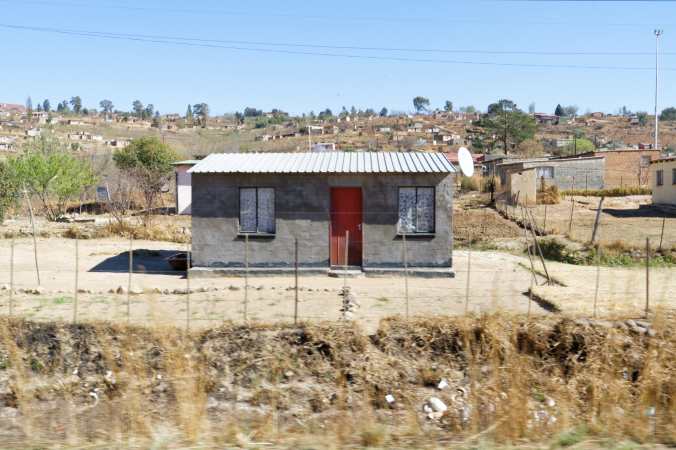
The gaping inequality is literally impossible not to see because it is manifest everywhere. Sumptuous villas sit a stone’s throw away from shacks.

Gleaming shopping centers share roadsides with garbage strewn shantytowns. Just sitting and writing about these human and inhuman contrasts – as it further focuses my attention on them — increases my already considerable disgust that has been our constant companion in this country of uncommon natural beauty.
We sailed through the entry sequence at the Johannesburg airport, got our Toyota Rav 4 for the expected rugged driving in the rugged areas, and headed, only several hours behind our initial well-laid schedule, straight for the Drakensberg Escarpment. It didn’t take but a few blinks of the prepared but still disbelieving eyes for us to be introduced to the physical squalor of the “settlements” and the individual structures which shamefully qualify as homes, to which so many black South Africans, though no longer legally so, are effectively still confined.

Of course, in Tanzania, a much poorer country, with per capita GDP not even one-fourth as high as South Africa, we saw much poverty and “homes” which, in their inadequacy to their name, would break your heart should it not be of the hard-hearted variety, which we have good reason to believe characterizes many of the more materially fortunate hearts here in South Africa. But to see the contrast, to put it starkly in coloristic terms, between black and white in South Africa, and to know that the abject physical, social, and security conditions in which so many blacks live here is systematically structured by race, by once-racist law, politics, and state-violence, and by the ongoing thoroughgoing legacies of this racism, makes the impoverished physical lives of black South Africans so much more disturbing.
The beauty of the Drakensberg is overwhelming.
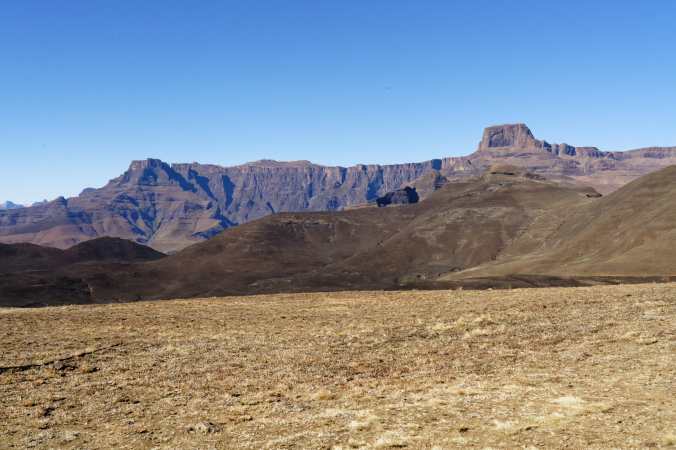
As much as anything could clear the moral and human mental-stench from our minds, Drakensberg is it. When below the escarpment, and when above, it offers breathtaking views on the order of the Grand Canyon, as different as the formations, stone, and coloration are. I hope Sarah writes about it, for two reasons. Her hand is niftier for using words to convey what we saw, which she also sees better, as she has the better eye. Second, she saw more, because she climbed to the glorious top, which I did not because my vertigo finally got the better of me when we came upon a six-inch ledge above a straight drop down. I turned back, while Sarah went on alone, as spry Gideon much earlier had steamed ahead with a couple from the Netherlands. As we couldn’t count on cell-service to communicate with Gideon, Sarah had to venture on solo because we couldn’t leave Gideon, uninformed, on the mountain alone. When I started to descend from the high-point of my vertigo, we, a solid-threesome starting out, were, as far as Sarah and I knew, three isolated individuals — not ideal on a climb which is dangerous, even if it is not the north face of the Eiger.

Sarah and Gideon finally met up on top, shared memorable views and times, and touched-down safely and fulfilled about four hours after Sarah and I had parted. Sitting and writing in our lodge’s restaurant/common area, I was relieved when Gideon texted me that they were driving back from the base of the climb, as his words washed away my many worries about their safety. No surprise, I was even more overjoyed than usual to see them, and to hear their tales of climbing courage and visual wonders.
–Danny


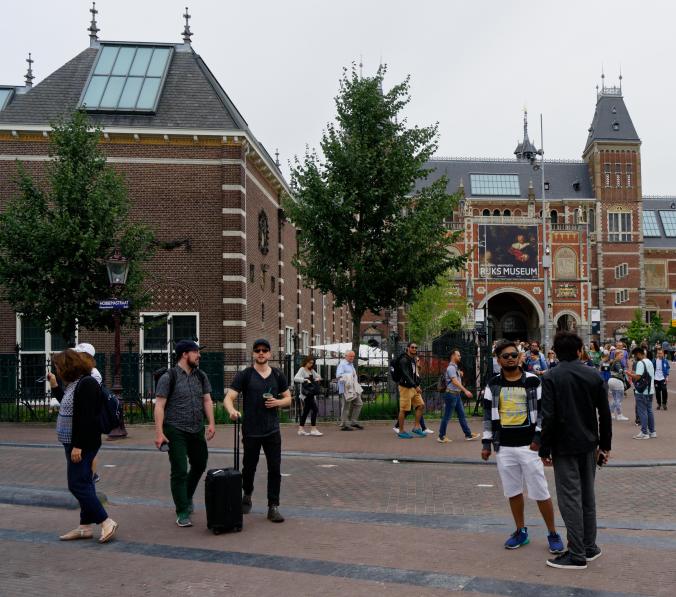

 We had a fine day and previous evening in Oslo, mostly walking and taking in its distinctive urbanity and its fabric, mainly known as buildings.
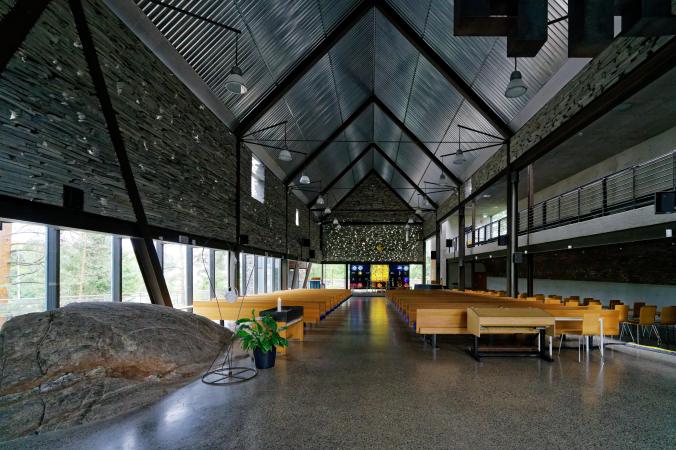 In the early afternoon, just as it was beginning to rain, we visited and marveled at Snohetta’s renowned Opera House.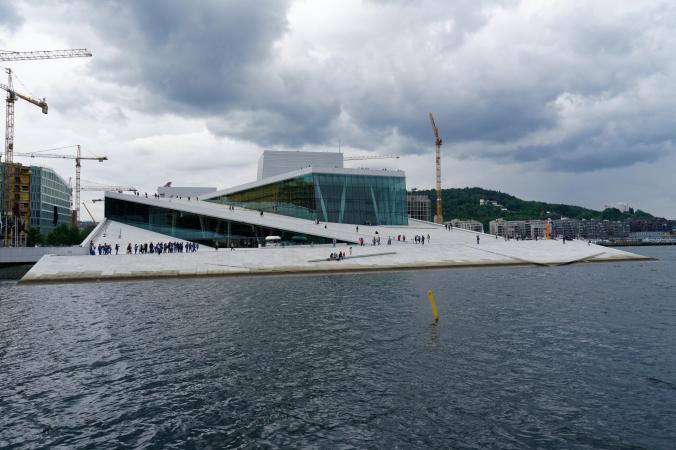
 Sarah and I set out on our adventure with the purpose of writing books, one by her and one by me, very different in character, each possible only through this long journey. More on them in a moment. We also set out committed to the writerly experiment of this let-the-spirit-move-us collaborative blog, which includes Gideon, who, I hope, will make his entry here soon and thereafter frequently. For Sarah and for me (about Gideon, who also has other writing projects, I’m not sure), the question of what goes where is live, and, at least for me, has not been resolved clearly.
  Roughly speaking, my schema is to offer you accounts and observations about the world out there which we encounter on our carefully chosen itinerary of barely scratching the world’s surface, even with a year of scratching at our disposal. The inner workings and inter-workings of the three of us – what it is like to travel with two loved ones for a year, and how the many and ongoing encounters with one another and with the offerings and demands of the world we will wend our way through affect and change us as individuals and in our relationships as parents and child, as married people, as individuals positioned differently in the ever-changing arrays of living – these things about us are the stuff and soul of the book. The rub might be obvious: the line, actually lines demarcating what’s out there from what’s in here (the family circle and each of our minds and hearts) is hard to draw, especially as the inside is implicated in the outside, most essentially because both constitute and are filtered through experience, thought, and language. (Taking and posting photos – Sarah’s and Gideon’s domains – are more clear cut.) So, deciding what’s in and out of the blog, because what constitutes the in(side) and the out(side) of the respective worlds we are living and seeking to understand is often indeterminate, is an ongoing and inherently messy and probably shifting process which I am negotiating with that very tough and a bit ambivalent negotiator, myself. As to the other negotiator involved here, I think less beset by this manner of thinking, I’ll leave it to her to engage her blog/book issues herself.
 Lofoton, above the Arctic Circle in midnight summertime sun Norway, was a spectacular place to begin our journey. The breath-taking and -giving monumental landscapes, which can be imaginatively discerned well enough through the miniaturized photos (which I expect Sarah will happily insert), as a undulating symphony of approachable mountains and hills, and lakes and fjords. We drove for hours through it at nearly every hour of the 24-hour day, including 1 in the morning, 5 in the morning, 9 in the evening, 11 in the evening and the more conventional sightseeing times in-between. Riveted and scanning, still and pointing, quiet and in full conversation (see shadows above), we drove, we walked, we looked, we breathed, we experienced Lofoton. For two days our ordinary rhythms of sleeping and waking, eating and… we cast asunder. We walked (see Gideon, double above), we hiked (straight up a small mountain nearing midnight), we drank coffee outdoors in the just warm enough weather, as we lived according to our own time- and activity-wants. We valiantly twice tried to see the sun at solar midnight descend, bounce, and rise slightly above the horizon, and failed for differently reasons. The attempts felt (in our exaggerating subjectivity) near-heroic, so we, the reasonable agents we are, felt disappointed yet satisfied that we had done our best. And so, we have yet another reason to return to Lofoton, to find and follow the midnight sun.

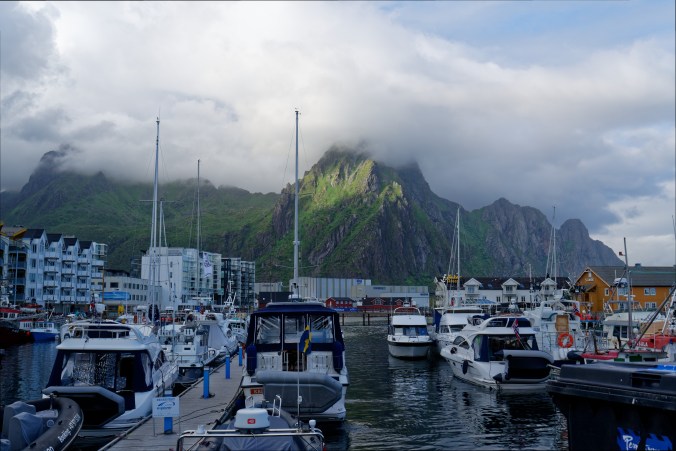 Evidence of human settlement stretches back 11,000 years. Since 800 CE men (that’s right, men; I know because of a photograph of Sunday worship in Lofoten Cathedral, ca. 1895) have migrated here in the winter and early spring, following the cod, who come to the area to spawn. One of the early Norse sagas tells of one Viking who sailed to England after a fishing expedition, and traded reams of dried fish for other essential goods. Whole, split dried fish hangs everywhere, even in the local equivalent of a 7/11.
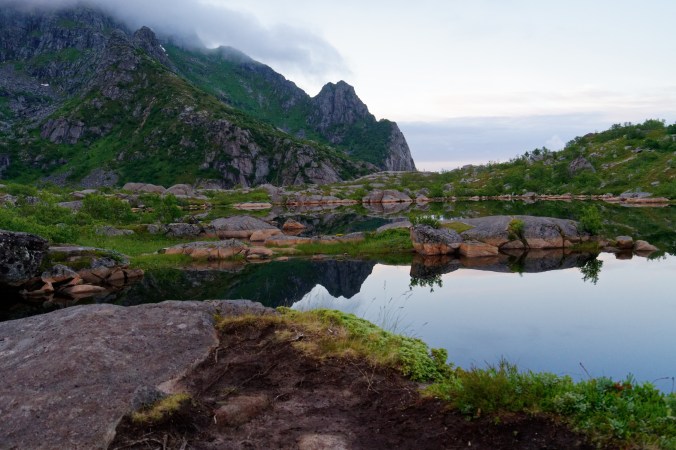 Dawn follows sunset within the space of half an hour: one moment, daylight is a golden red; the next, a cool morning blue. Astonishing. As if the world is birthing itself anew before your eyes; the diurnal cycle of hours unending, a joyful noise unto the interstices of time. And yet my mind rushes to imagine its biannual opposite: here, Nordspeople living in unremitting darkness for many winter months.
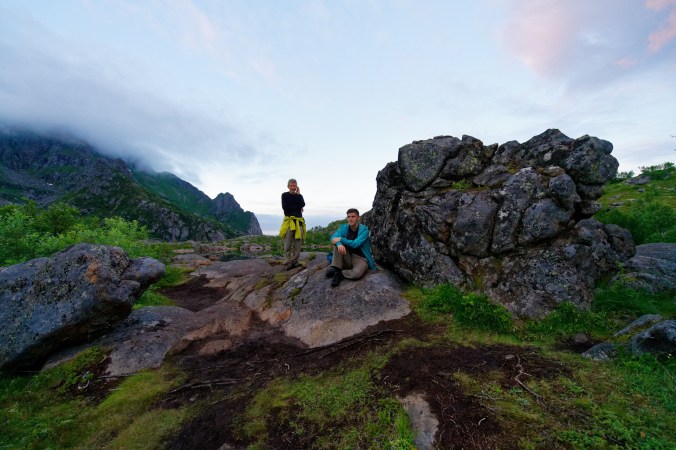 Last night, as we drove back to our Svolvaer flat at 1:30 am following a midnight hike in Henningsvaer in failed chase of a full view of the storied midnight sun (failed because, at the critical moment, we lacked the necessary northern sightlines), I noted that home after home in this town left a light illuminated indoors. They couldn’t get enough of it, even during the summer, I thought, perhaps a bit morbidly.
 Looking out a window: rays of sun shine between the mountaintop ridge and the fluffy cumulus. Walking the street from home to café beneath a looming cliff. Crisp air everywhere: it’s mid-July, and hovering around 50 degrees.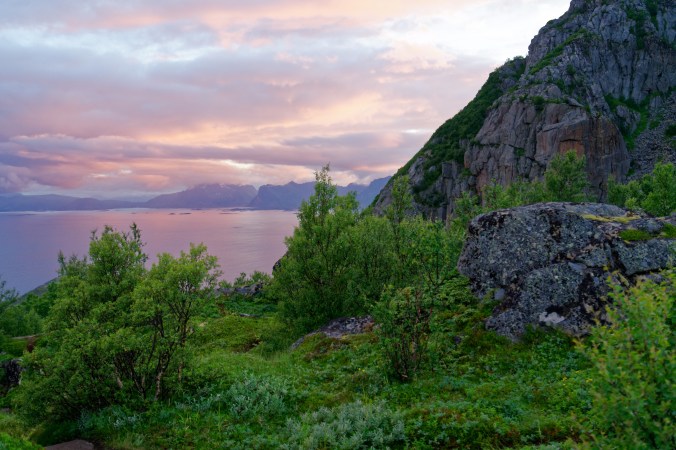
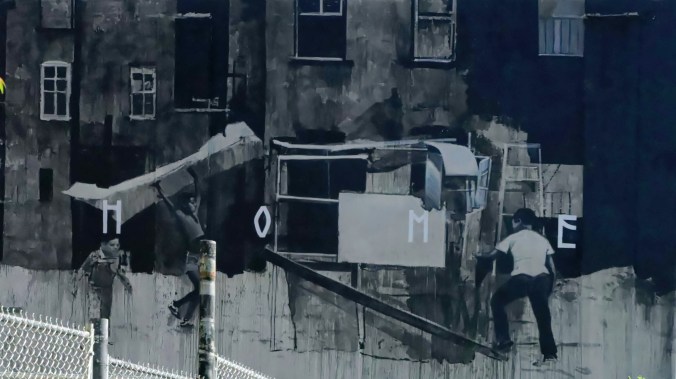 We’re traveling. To a lot of places, on six out of seven continents.
 The quotidian: we’re frantically trying to organize everything, financial, virtual, physical. Transfer responsibility for bills to a virtual bank. Prepay maintenance fees, due in January. Who’s going to shovel the sidewalk this winter? Water the plants? Will the vacation override from our health insurance come through in time to allow us to secure needed medications?

 Coordinating Goldhagens