The flight to Morocco lasted twenty-five hours, thanks to two things. Nonstop flights among African countries are often non-existent and connections can be circuitous and rare. Many travelers between two African countries find themselves connecting in Europe. We had that option for booking a path between Windhoek and Casablanca, but instead opted for the Gulf, going through Doha with a midnight connection between the two flights, as this offered the best (which is different from a good) itinerary. Then, a couple or weeks before the trip, Qatar Airways rescheduled our initial departure (perhaps owing to the tiff with the Saudis and others, preventing Qatar from using a lot of airspace), rendering our connection moot, and mandating that we layover in Doha for seven hours, from midnight to seven AM. As we have become practiced long-haul travelers, the twenty-five hours did not pass too badly, in part thanks to the airport lounge we could use, where Gideon and Sarah copped beds for sleeping. I stayed up the whole journey, and happily worked and worked and worked, off and (mainly) on for the long day. As I had a manuscript I was close to finishing writing at hand and I wanted to make a full run-through it, I had (for me) a perfect sustained project to keep me going for the trip.
We arrived to the ninety plus degree heat of Morocco after spending a month in overall coolish (some warm) weather. If I were differently oriented, I would offer a disquisition on the many ins-and-outs (more like ups-and-downs) of weather for our travels. All I’ll say here is that the heat was at first appreciated, though, especially as time wore on, less so by me than by Sarah and especially Gideon.
Upon landing, we procured our rental and headed for Marrakesh, which, three hours later, presented such a charming and salmon colored (the hue of virtually all the buildings) bustling face,
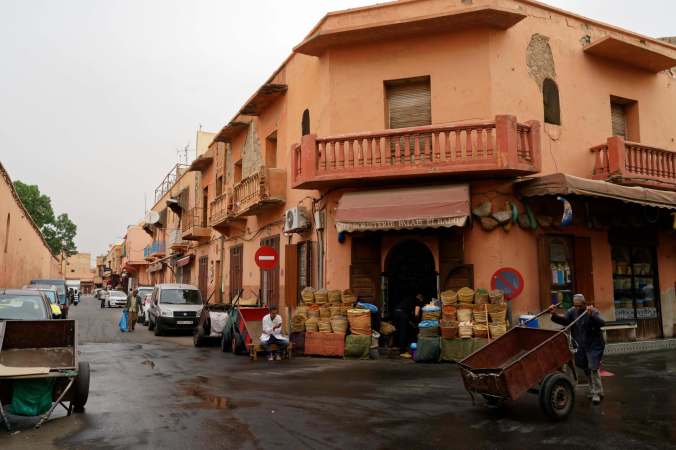
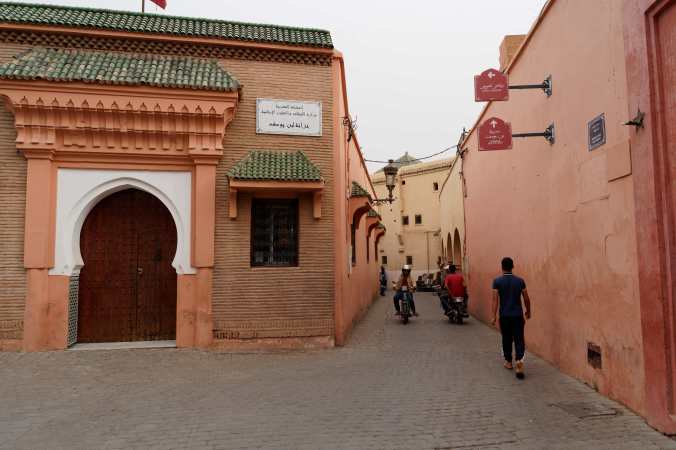 that Gideon and Sarah, immediate enthusiasts, lobbied for staying even longer than the planned week. This was even before we saw our Airbnb riad in the medina, with which they instantly fell in love.

 A consistent theme of our time in Morocco was that I liked what we saw and what we did somewhat less well than they did. To what extent this was owing to our different appreciations of the temperature, different temperaments regarding the hustle and hustling of the medina (where we walked with big targets on our fronts and backs), or differential ability to ignore or look beyond the manifestly subordinated place of women, rather than to different judgments about what is interesting or meritorious, is hard to know. Nonetheless, Morocco certainly presented a different face, or many different faces, from what else we had seen in Africa. This alone made it interesting.
Our stay in Marrakech centered on the medina, which is the interior of the old walled city, where we became instantly almost locals,
 traversing the narrow alleyways of our residential area to the end of what was a dead end where our entrance lay. Once inside, courtyard open to the sky,
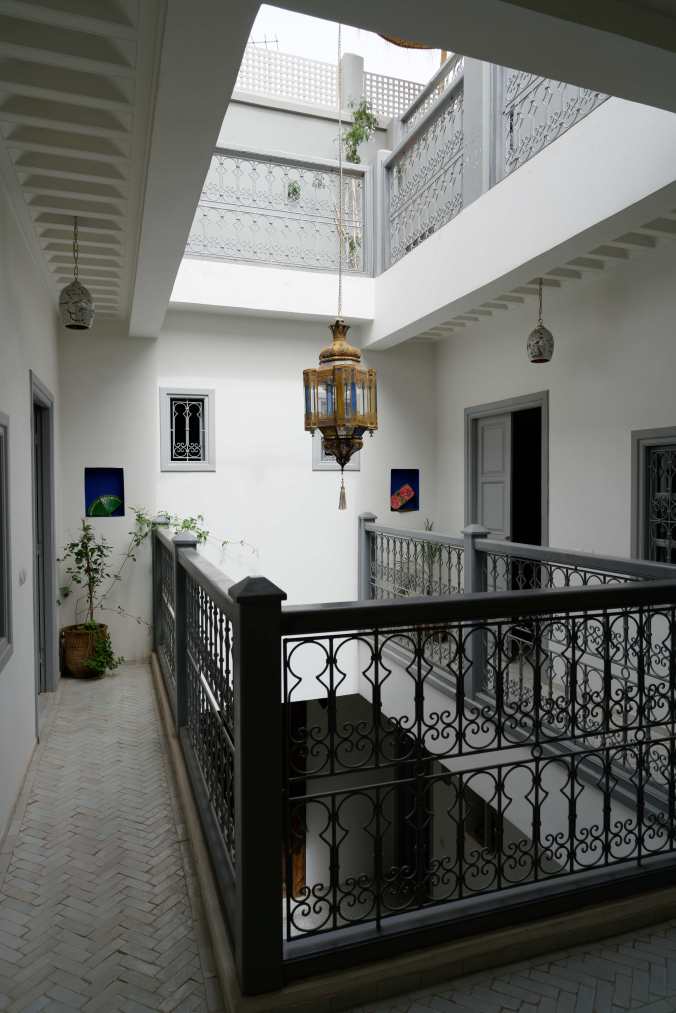 we were contained in our own mid-century, stoned Moroccan world, except for the five-times daily (the first occurred at 5:45 AM), insistent call to prayers to the various nearby mosques, which loudspeakers made impossible to ignore.

Kasbah Mosque, Marrakesh
I joked with Sarah that it was great, just as it would be to have a guy put his head through your window and shout into your house. Anyway, we rather easily got used to this characteristic feature of Islamic countries, though we also learned that the volume and character of the call to the faithful varies. In Casablanca, we stayed a (long) stone’s throw from the gargantuan Hassan II Mosque, the largest in Morocco and one of the largest anywhere.

Hassah II Mosque, Casablanca
Its call to prayers are less intrusive, more subtle, and, to my untrained ear, more melodious.
The medina, with narrow streets and pathways, ancient chaotic feel, non-stop small commercial activity – an offer, a deal, a special price just for you, at every step – is worth a visit or two, so you get a sense of what the world of the Marrakech, perhaps the Arab, market once was like.
 Of course, today most of it is oriented to tourists, with on the whole more appealing offerings (rugs, ceramics, silver and beads in all kinds of constellations)
 than the norm, but especially where we were, it also provided the lifeline of daily needs for the inhabitants – small grocers, stores with household essentials, laundries, and cafes for the men (singly, paired, in clusters) to while away the day.
After a few days of wandering the pathways and byways of the medina, including in the further walled-in Kasbah, and seeing its prosaic and more touristically sacred sights, we had had our fill of the new-old (which by then had lost much of its luster), and spent more time in the unabashedly newer part of Marrakesh, which is a modern and expanding city, except perhaps in its monochromatic insistence. (The riad, open to the sky and with its roof deck, continued to capture Sarah’s and Gideon’s fancy, while I had had more than enough of its walled-in offerings.) We finally got around to visiting the Jardin Marjorelle,


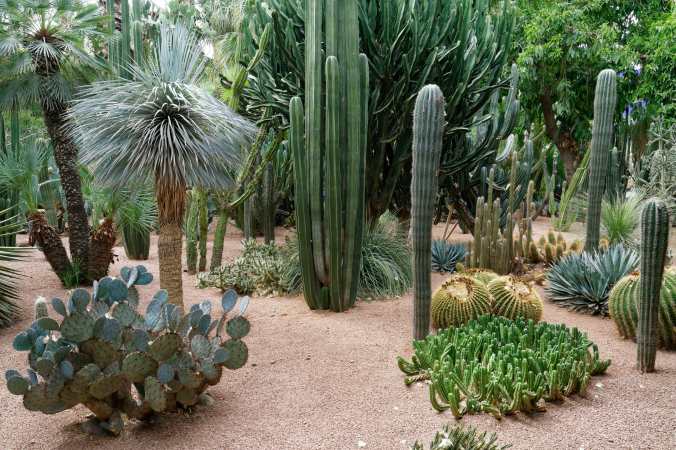 a garden of desert plants, purchased and rejuvenated by Yves Saint Lauren and his partner Pierre Berge. It is as memorable and spectacular a contained garden as we have seen, a fiesta of specimen planting and display, with cacti of every sort as beautiful and wholesome as even your imagination could want. Marrakesh has its charms and its magical salmony-colored quality, rendering it, together with its impressively massive walls and the medina they enclose, a city of distinction, and worth visiting. It’s historic and contemporary marquee attractions – including palaces and tombs, museums and villas – are however mainly underwhelming.
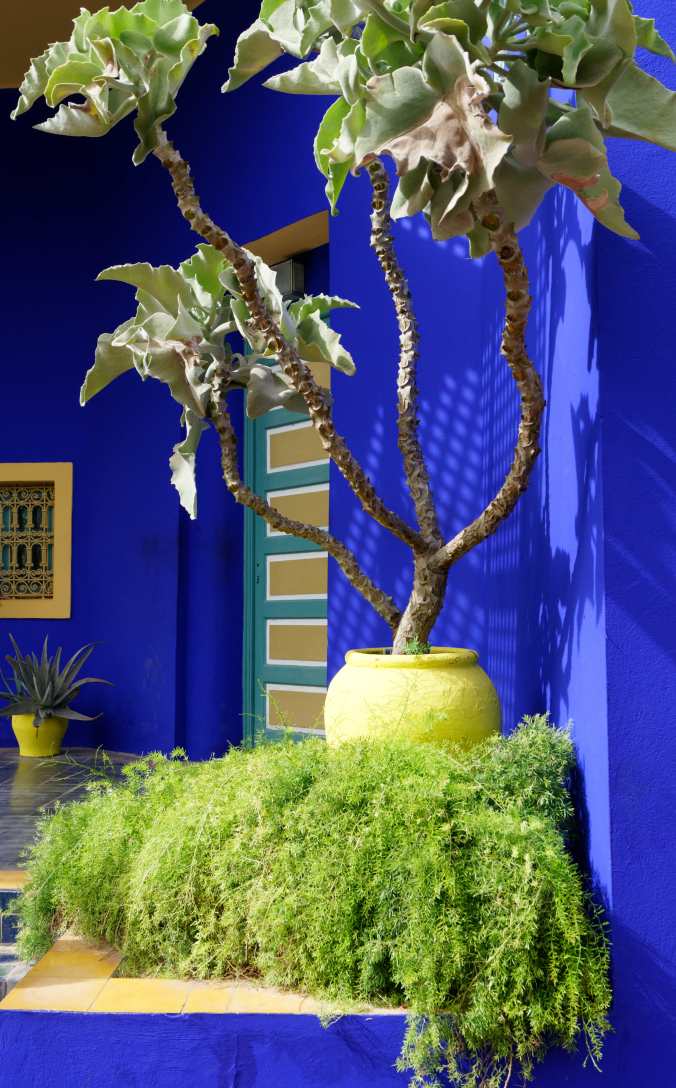 But the Jardin Marjorelle… the magical Jardin Marjorelle…
— Danny
 The stunning and varied non-Namib landscapes, especially between Sesriem and Walvis Bay, which Sarah described moving through — having over the last few months experienced a range of unforgettable scenic road trips — as one of the best drives ever.
 The idiosyncratic hotels we stayed in in the desert, the first being an expensive contemporary castle (at least in wannabe form)
  and the second being an inexpensive “desert farm” with as beautiful a desert garden as you could want.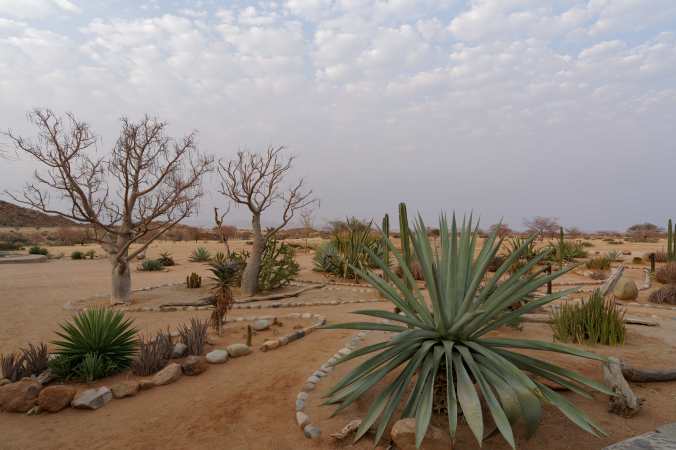
 The sunrises.
  The walk from the castle hotel just out there into the desert, with the sense that we could have gone on forever (or until we died of thirst).
  The totally (–>this is no hyperbole) unexpected excellent coffee shop and bakery in aptly named Solitude (it’s a few structures strong) — started fifteen years ago by a man who fled his broken life, started anew in this middle-of-nowhere, and, loving it, never left. The lovely small book store in Swakopmund, with books in three sections, one for German, one for Afrikaans (probably, the lingua franca of Namibia), and one for English, and containing an impressive multilingual section on Namibia with many books on the colonial period and the genocide. The good-naturedness and easy-goingness of all the people we met.
  The personalized, memorable short week we spent there made Namibia (for the supertough raters) a nine and (for the simply experientially-tuned) a flat out ten.
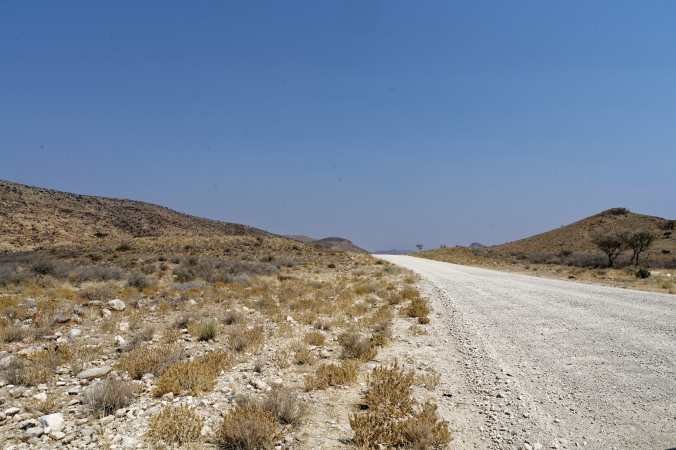 Only one paved (in local argot, sealed) highway, admittedly with arterial branches, stretches from north to south; a second, west-east, connects the adjacent towns of Walvis Bay and Swakopmund on the Atlantic with Windhoek. This one runs through the most economically developed regions of the country. Mostly, mines: diamond mines, copper mines, tungsten mines, and two of the top-ten uranium mines in the world.
 The wide, long, rattling journey from Sossusvlei to Swakopmund will surely always be one of most beautiful drives I have ever had the good fortune to enjoy. It’s not spectacular, like the drive from the San Francisco Bay Area up to Sea Ranch on the Pacific Coast, or the drive from Geneva to Lausanne. You really have to watch. I passed the hours gazing out onto these often flat, sometimes rolling expanses of land, parsing out how the sense of deep space came mostly from variations in color saturation, hue, and temperature,
  and noticing subtle shifts in the layered bands of browns, grays, thin, struggling greens.
  When the arid ground shifted from flat and sandy to inclined and rockier, my heart leapt, delighting in the textural variation.
 Nothing, nothing, nothing. Until you realize that nothing is something. Burrow into these muted colors and thin layers, into this topography. This landscape settles inside you, then stays.
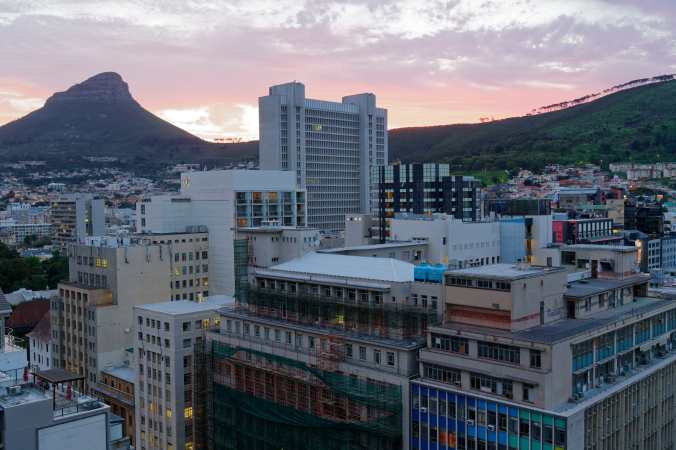
 Paved streets. A new shopping mall under construction, outside of town. Two-story concrete frame buildings – nearly everything is concrete frame, not steel– housing the warehouses and offices of various local companies.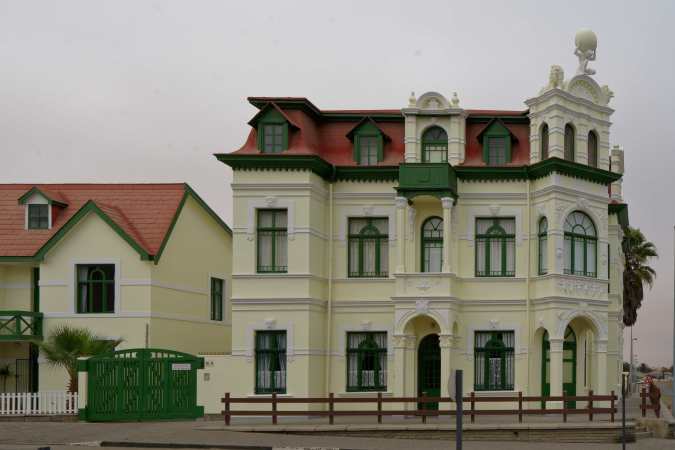
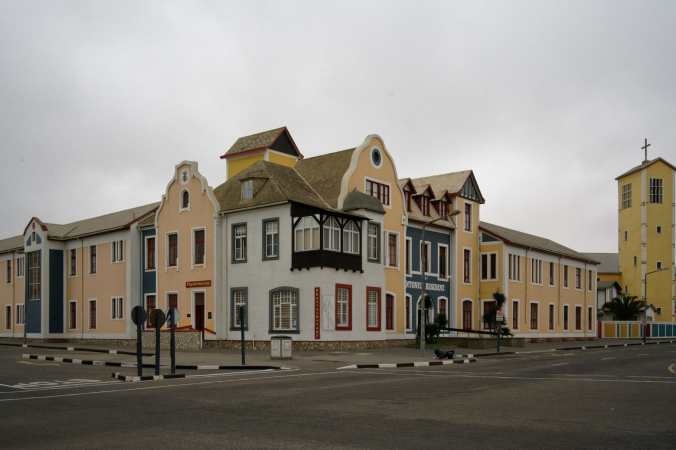
 At the edge of the commercial area, near the shore, sits a little enclosed complex with an arcaded courtyard and a charming lookout tower; once, it housed a boarding school.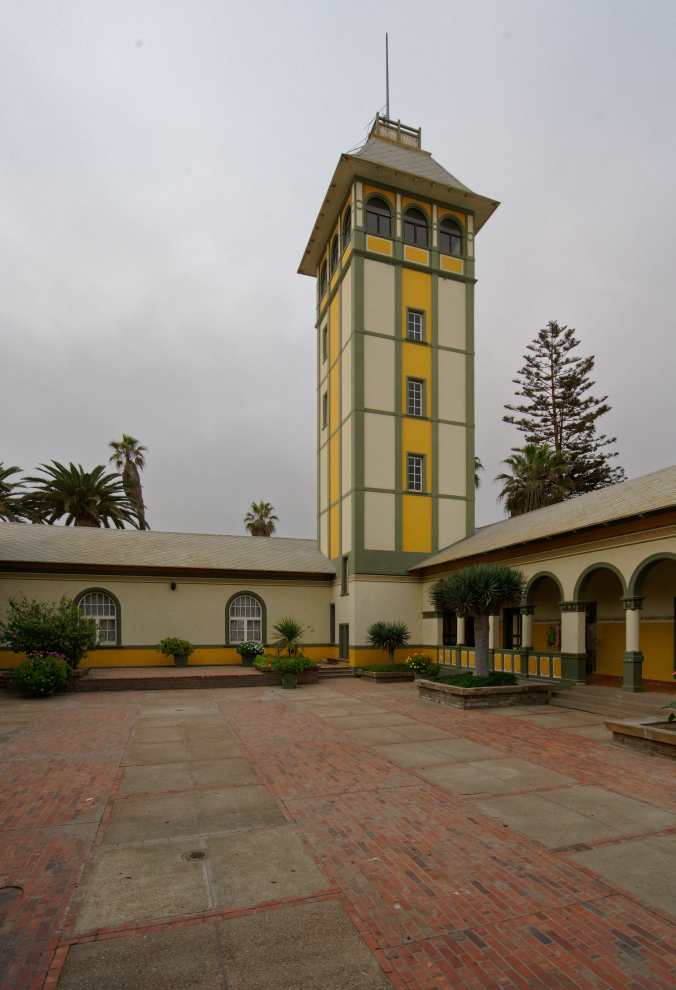

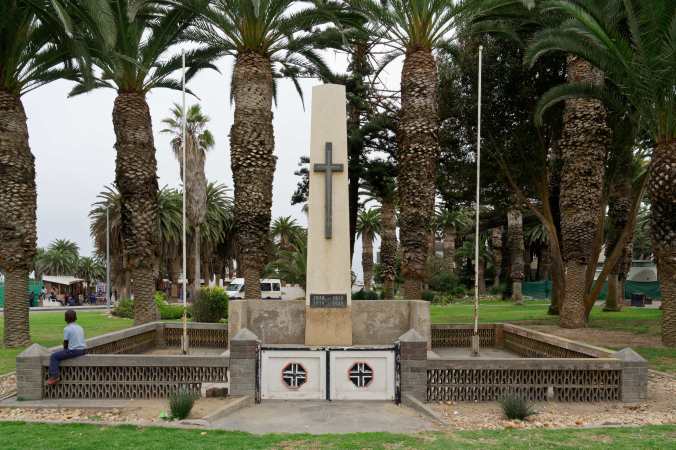 To locals, this place, like the graciously-planted, serpentine beachside pathways, was just another instance of tidy Swakopmund’s gracious provision of landscaping and street furniture.
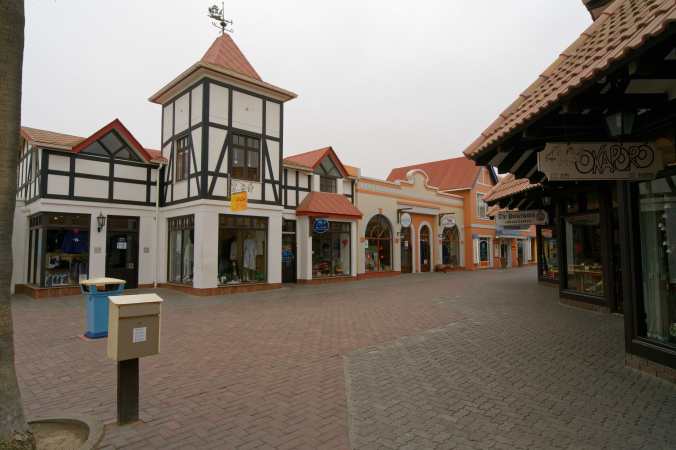 In it was an excellent new-and-antiquarian bookstore, filled with German-speaking latte-drinkers and German-language paperbacks.
 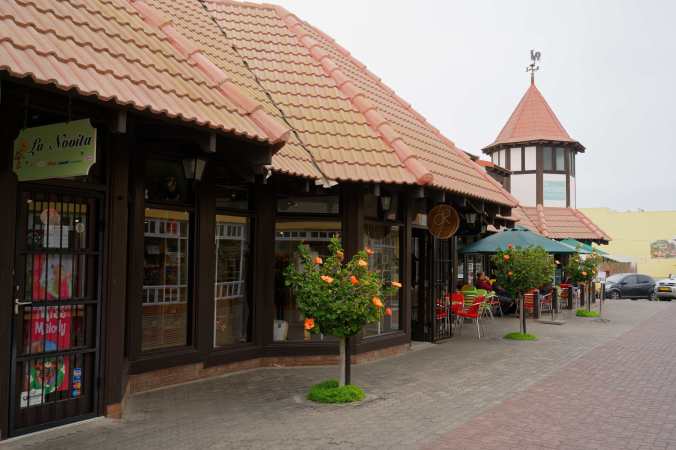 We poked around for a good half hour, turning up a battered Herero-German dictionary, published in 1904.
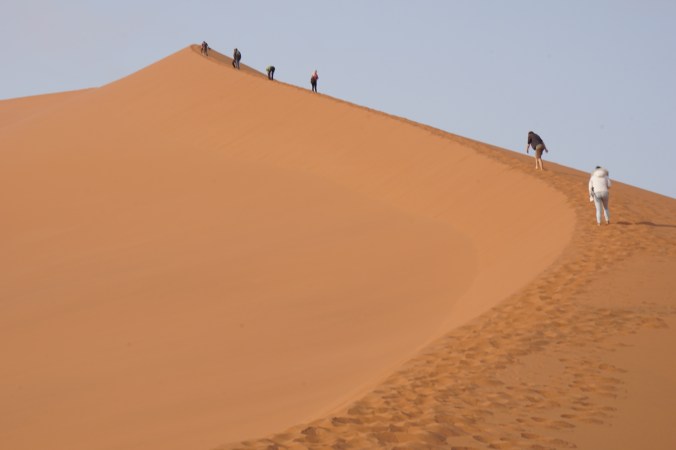
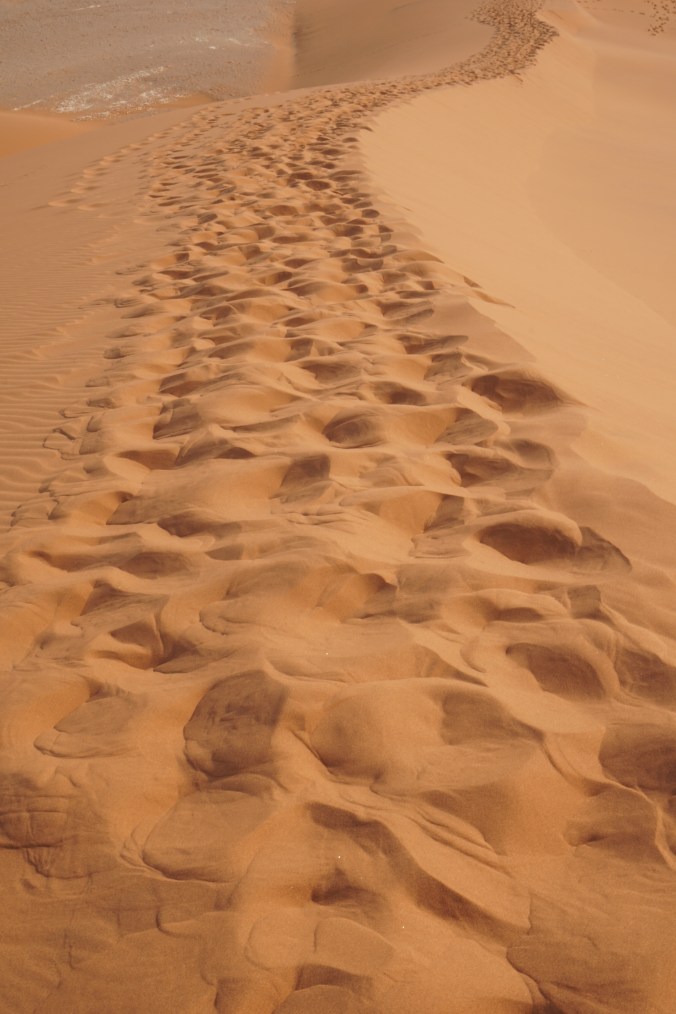
 We gazed upon them. We walked past and around them. We climbed them. We (Gideon and Sarah) stood astride them and surveyed the dominion. Gideon lay on them. He even, unsuccessfully, tried to roll down them, only to discover that they enveloped and captured his body as they had his imagination and soul.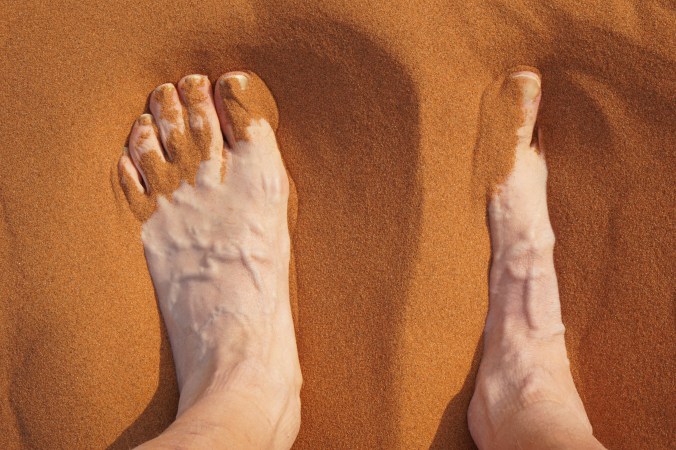

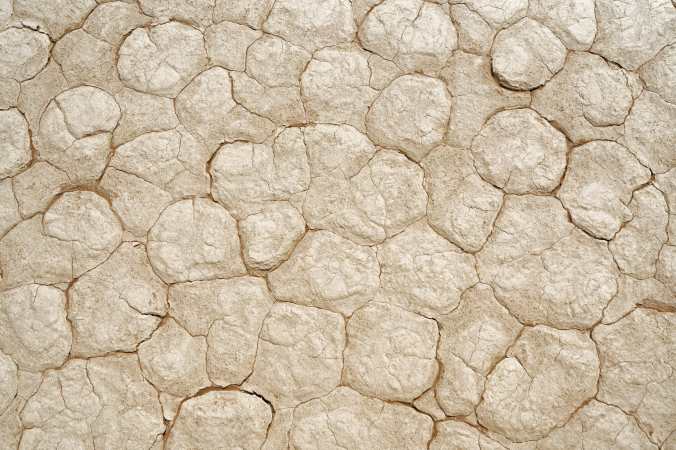
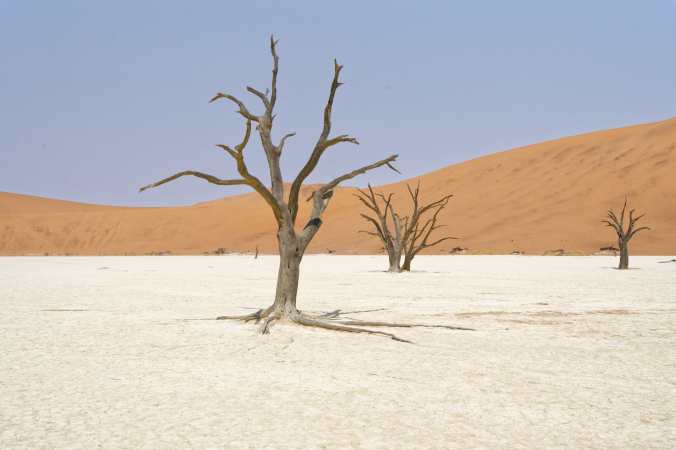
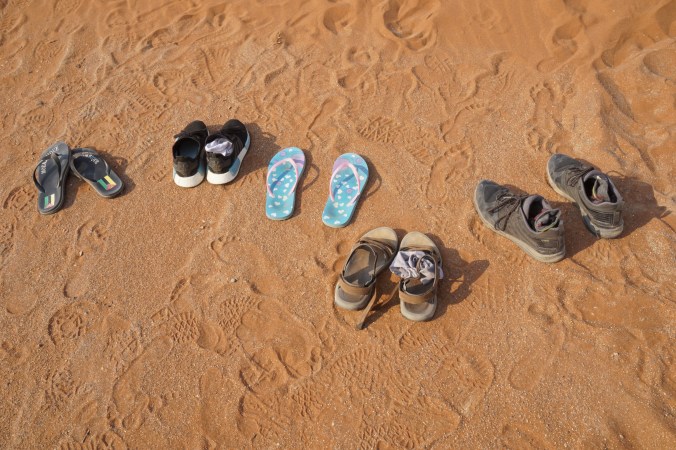 reassembling at our SUV, driving further into the dunescape, taking a four-wheel drive sand-ferry for four kilometers, and trekking afoot twenty minutes deeper up into the dunes, we came upon the nearly sacralized desert landscape, foremost among desert moments in the world, of Deadvlei — to wander among, behold, and contemplate, and, in Sarah’s and my case, talk about the dune-flanked and framed magnificent salt pan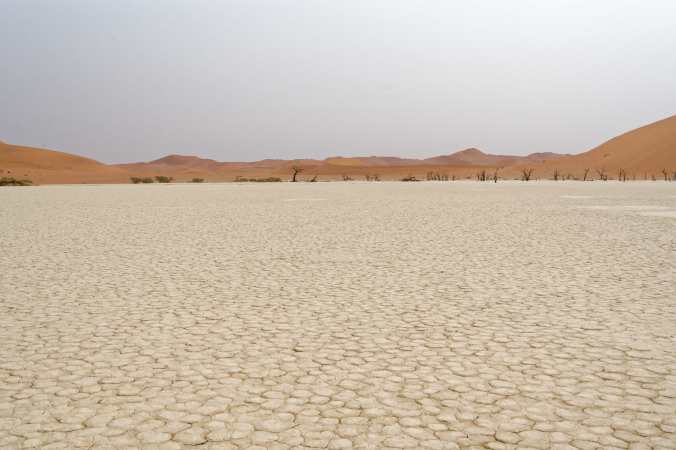
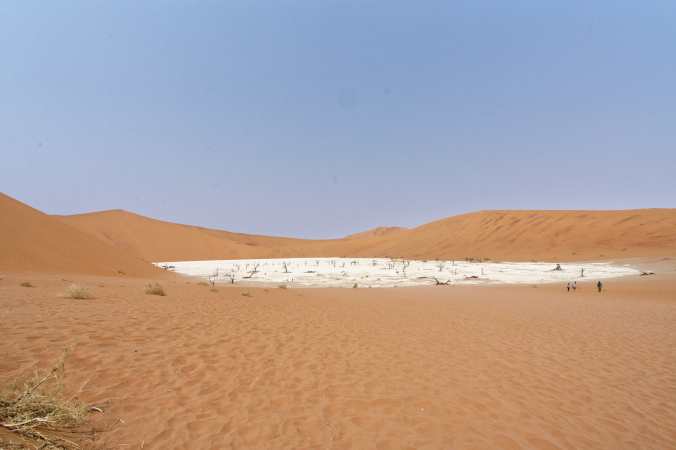 and anything, which was plenty, that the embodied mind of being there conjured up for the hour or so that we basked in this and our singularity, and in our commonality of sharing this place and our lives.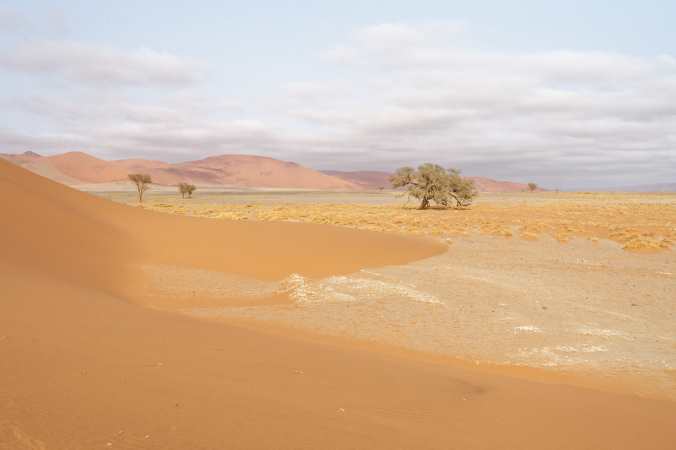

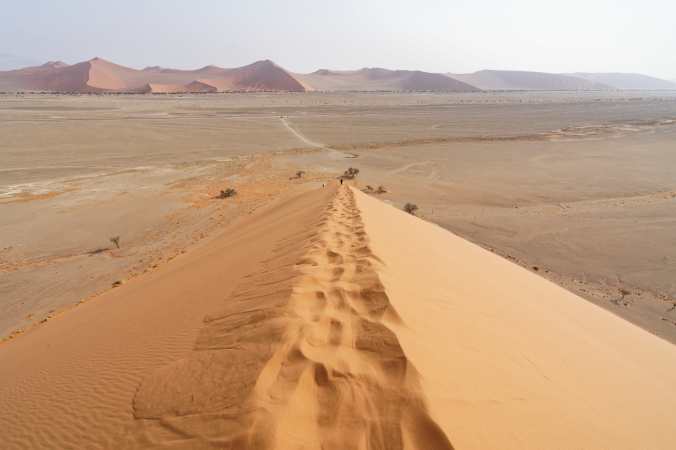








![IMG_6544[15644]](https://coordinatinggoldhagens.com/wp-content/uploads/2017/09/img_654415644.jpg?w=676) (Every guidebook will advise you to be prepared for these, and my experience on them was, I discovered, shared by all my fellow hikers. We all thought we were prepared. No one was prepared.)
(Every guidebook will advise you to be prepared for these, and my experience on them was, I discovered, shared by all my fellow hikers. We all thought we were prepared. No one was prepared.)![IMG_6539[15643]](https://coordinatinggoldhagens.com/wp-content/uploads/2017/09/img_653915643.jpg?w=676)
![IMG_6552[15646]](https://coordinatinggoldhagens.com/wp-content/uploads/2017/09/img_655215646.jpg?w=676)





 Coordinating Goldhagens