Gracious wins my vote as the word that best describes Oslo. The capital city of one of the world’s wealthiest countries, sidewalks are wide, cobblestoned paths and alleyways well-maintained, 
and its abundant public spaces carefully, thoughtfully designed.

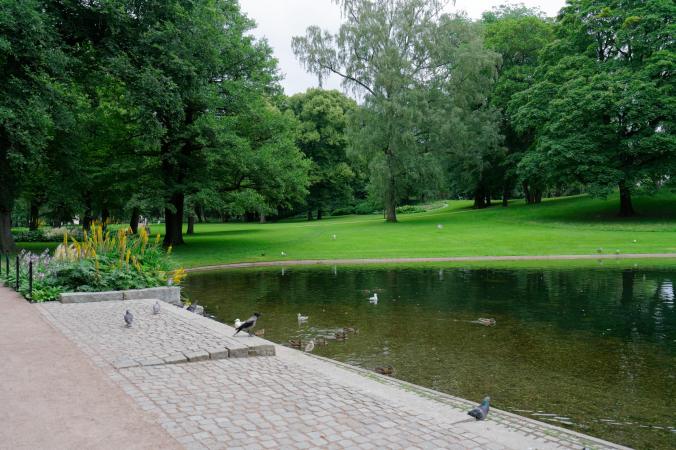
Parks are everywhere, although for overall greenness, several studies, including this– (https://www.siemens.com/entry/cc/features/greencityindex_international/all/en/pdf/report_en.pdf) — indicate that Copenhagen and Stockholm surpass Oslo, though not by much.
 In many open areas and public spaces, art installations are carefully installed, including this one, which combines a phone charging area and seating. The public art varies widely in quality, at least it’s there.
Anker Brygge, the newly developed waterfront area, looks out across water onto Snøhetta’s Opera House and Ballet Theater, which is as good as its press indicates.
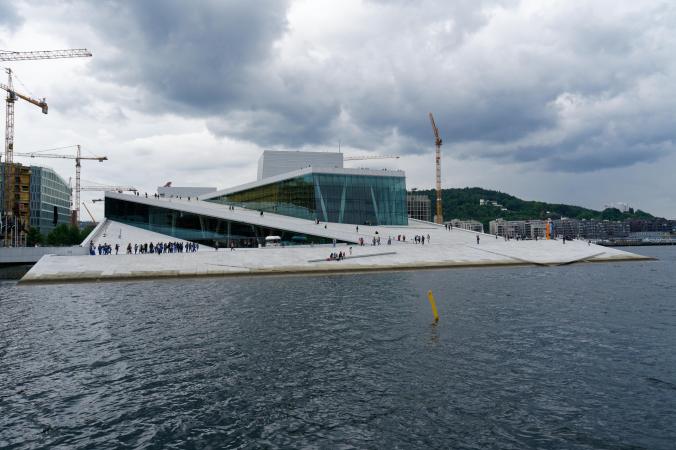 Not a great building, but an excellent one. (Few projects of any sort, artistic, architectural, or literary, rise to the level of great.) All over Anker Brygge, new, new new:

Renzo Piano’s Astrup Fearnley Museum bridges the end of a long boardwalk which, at its opposite end, is edged by a few older warehouse and storage buildings, meticulously renovated, along with many newer mid-rise commercial and residential buildings.
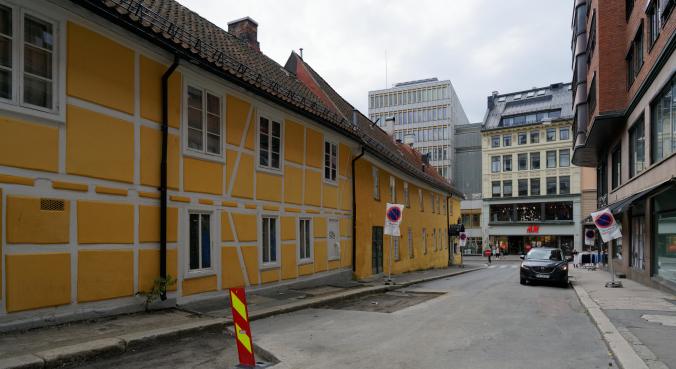
This time it was Danny, not I, who fantasized about spending some time every year in a place we’ve traveled to see. More commonly I am the one who pokes around the nicer places we encounter– Marbella, Spain; The Sea Ranch in northern California; the Lakes District in England — all have received their due consideration, all for naught. Here the reverie evaporated rapidly: real estate agencies advertise both new and older residential properties at staggering prices: $2.3 million for a 500-square-foot studio apartment.
In the older part of the city, my favorite place became the Oslo Cathedral and environs.

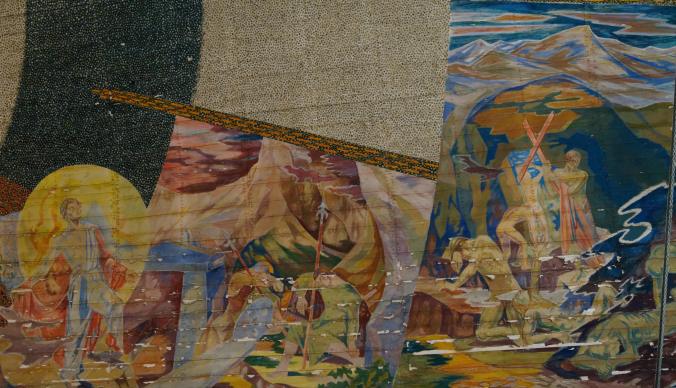
The Cathedral is the most spacious 17th-century central plan church I’ve seen, and has a barrel-vaulted ceiling decorated with murals painted in the 1950’s narrating the life of Jesus – each episode carefully drawn in a Norwegian landscape.
To one side of the cathedral sits the Basarhallene, an arcaded brick neo-Romanesque courtyard built in the mid-19th century to house butcher shops. Even it is graciously arranged and beautifully detailed.
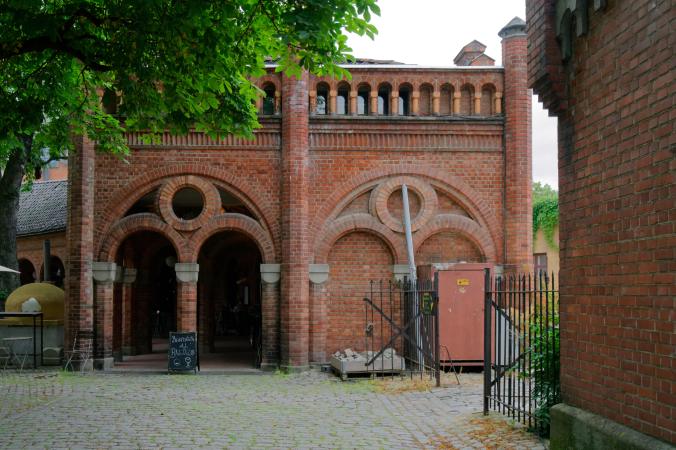
In our walking, walking, walking, we also ran into the old copper-banded, round-cornered modern commercial building (ca. 1960) that I recalled seeing when I exited the Oslo train station in 1975, forty-two years ago. Hadn’t thought of it once since that day, and my recollection of it was pristine, clear, as if it was only days when I’d walked by it last. Unbelievable how place-based our long-term autobiographical memory really is: Just a glimpse snapped it in place.
Decided not to shoot.
Then in our perambulations around the city, we skirted the park in which I found a bench and, exhausted from a crowded, overnight train ride here, slept for several hours in the early morning sun. Later, Danny showed Gideon and me the exact spot where he lay down, at age 20, on the grass under a tree and also slept (pictured above). Gracious, peaceful. That is the experience of Oslo.
Accompanying me throughout Norway was Karl Ove Knausgård. I had read the first volume of My Struggle several years ago, and was impressed by Knausgård’s intelligence while at the same time I recoiled from his nihilism (“what was man on this earth other than an insect among other insects”), and endless self-examination. A couple of days before we boarded the plane bound for Norway, I decided it was time to give Volume Two a try. (In total, there are six, each between four and six hundred pages.) Better than One, Two narrates an account of his leaving his second wife in Norway and moving, somewhat impulsively, to “that shitty little country”, Sweden. There, he reconnects with Linda, a poet and dramatist five years his junior and falls in love with her tender, wounded soul; they become a couple, and Knausgård subsequently settles, uneasily, into a husband’s and father’s life.
As ever, Knausgård remains tortured.
Everyday life, with its duties and routines, was something that I endured, not a thing I enjoyed, nor something that was meaningful or that made me happy. This had nothing to do with a lack of desire to wash floors or change diapers but rather with something more fundamental: the life around me was not meaningful. I always longed to be away from it.
Yet each each successive account of his turbulent ruminations is recounted in such a soulful, authentic way that reading the book necessitates a depth of emotional involvement that is rare, even in the best literature. And his descriptions of life’s joyful moments absolutely soar. Some have called Knausgård a contemporary Proust, with all the insight and none of the lace: few metaphors; blunt, declarative sentences; exacting descriptions of life’s daily activities. An account of washing the dishes after supper or a trip to the supermarket can run five or ten pages; somehow, it just doesn’t become flat or dull. Curiosity compelled me to read on – did this account of Linda’s sour mood and petulant conduct (both of which seems to Knausgård’s specialize in) — portend an incipient crisis, or was it just another thing that happened in the course of that one day? As James Wood wrote in his review of the book’s first two (400-600-page) volumes, even when I was bored I was interested.
And his fond accounts of Norwegian cities, landscape and culture rang true, over and over again.
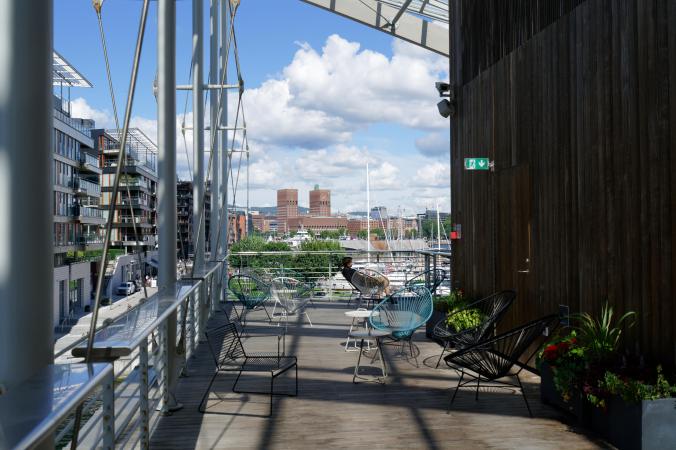
This is the Radhus, (City Hall) seen from the terrace of Piano’s Museum.
— Sarah, 30 July 2017, posted in Amsterdam, written on our last day in Oslo
 We had a fine day and previous evening in Oslo, mostly walking and taking in its distinctive urbanity and its fabric, mainly known as buildings.
 In the early afternoon, just as it was beginning to rain, we visited and marveled at Snohetta’s renowned Opera House.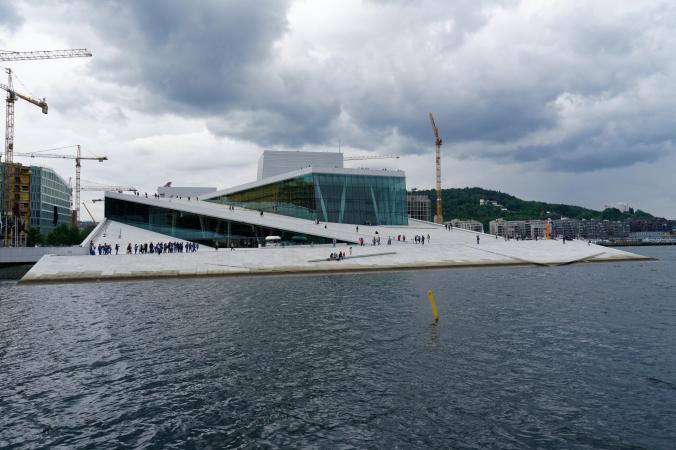

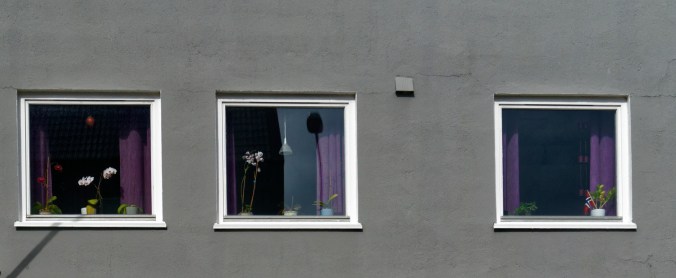
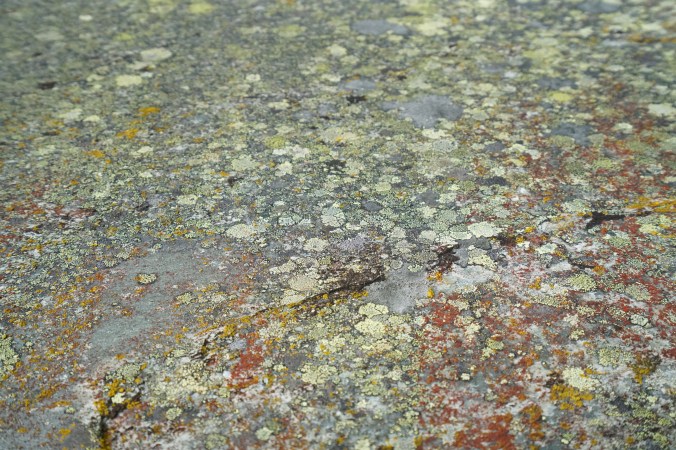
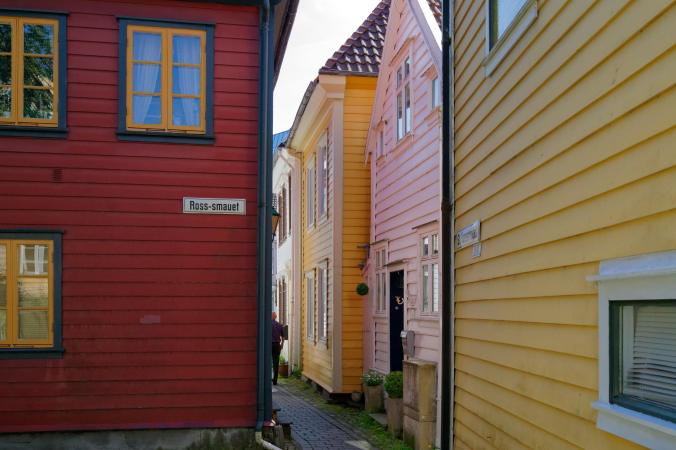 clouds and sky at different times of day. In landscapes, I’ve been gravitating toward imbalanced compositions – one side in deep shadow, the other suffused with rosy hues.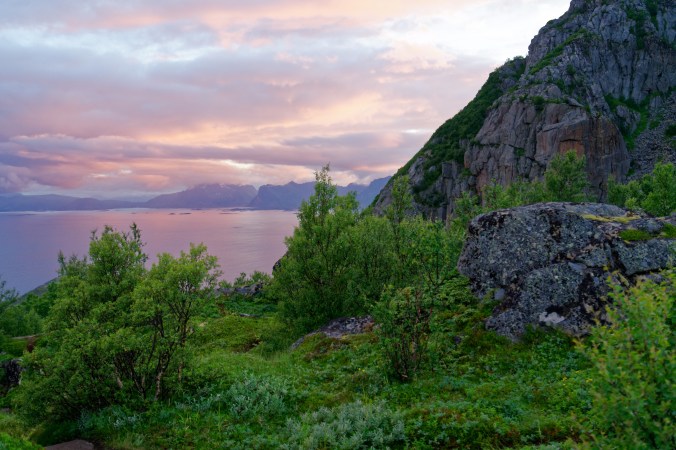
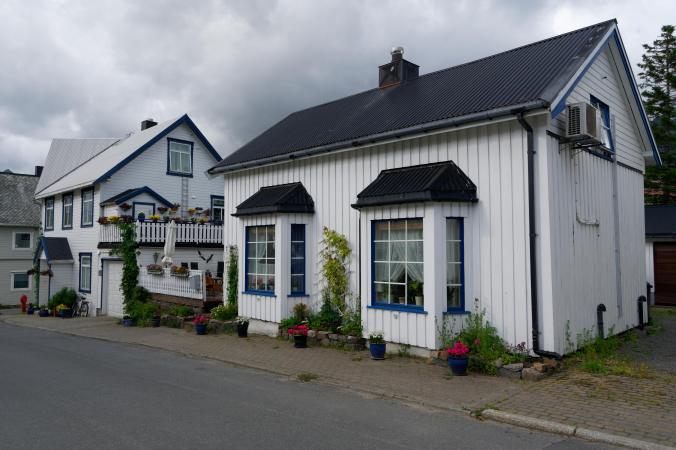

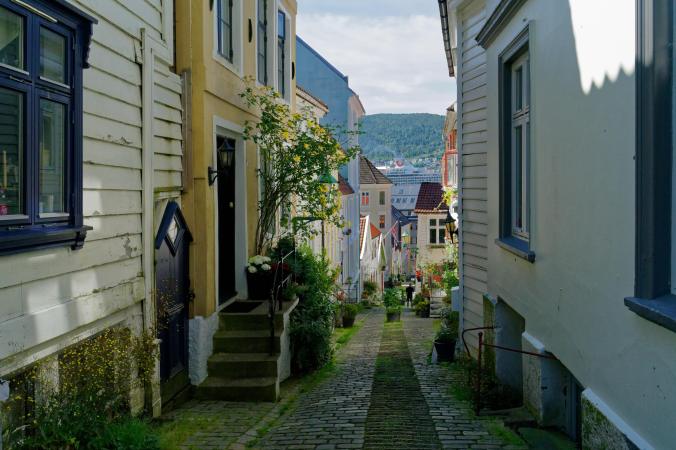 Grace, scale, detail, and color all contribute to the built environmental nobility which Bergen confers on its every inhabitant, permanent or itinerant.
  After the small human footprints on the experientially vast landscape of Lofoton, Bergen probably appears even more robust an installation of civilization than it is.
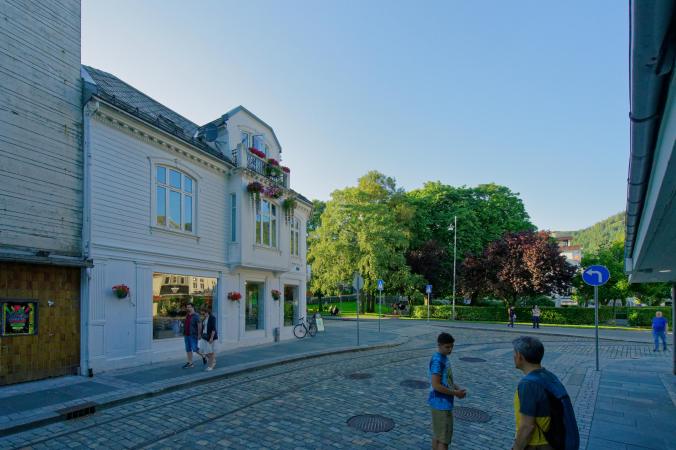 Each cobblestoned-step holds attention.
 Each house, or at least many, invites inspection, offering some reward in form, surface, or color, which is deployed without hesitation yet with a sense of composition and palatal restraint.
  It is also bustling, because the day and a half we are there are the warmest (mid seventy) and sunniest, so we are told by several people, yet of the summer.
  Sarah and I set out on our adventure with the purpose of writing books, one by her and one by me, very different in character, each possible only through this long journey. More on them in a moment. We also set out committed to the writerly experiment of this let-the-spirit-move-us collaborative blog, which includes Gideon, who, I hope, will make his entry here soon and thereafter frequently. For Sarah and for me (about Gideon, who also has other writing projects, I’m not sure), the question of what goes where is live, and, at least for me, has not been resolved clearly.
  Roughly speaking, my schema is to offer you accounts and observations about the world out there which we encounter on our carefully chosen itinerary of barely scratching the world’s surface, even with a year of scratching at our disposal. The inner workings and inter-workings of the three of us – what it is like to travel with two loved ones for a year, and how the many and ongoing encounters with one another and with the offerings and demands of the world we will wend our way through affect and change us as individuals and in our relationships as parents and child, as married people, as individuals positioned differently in the ever-changing arrays of living – these things about us are the stuff and soul of the book. The rub might be obvious: the line, actually lines demarcating what’s out there from what’s in here (the family circle and each of our minds and hearts) is hard to draw, especially as the inside is implicated in the outside, most essentially because both constitute and are filtered through experience, thought, and language. (Taking and posting photos – Sarah’s and Gideon’s domains – are more clear cut.) So, deciding what’s in and out of the blog, because what constitutes the in(side) and the out(side) of the respective worlds we are living and seeking to understand is often indeterminate, is an ongoing and inherently messy and probably shifting process which I am negotiating with that very tough and a bit ambivalent negotiator, myself. As to the other negotiator involved here, I think less beset by this manner of thinking, I’ll leave it to her to engage her blog/book issues herself.
 Lofoton, above the Arctic Circle in midnight summertime sun Norway, was a spectacular place to begin our journey. The breath-taking and -giving monumental landscapes, which can be imaginatively discerned well enough through the miniaturized photos (which I expect Sarah will happily insert), as a undulating symphony of approachable mountains and hills, and lakes and fjords. We drove for hours through it at nearly every hour of the 24-hour day, including 1 in the morning, 5 in the morning, 9 in the evening, 11 in the evening and the more conventional sightseeing times in-between. Riveted and scanning, still and pointing, quiet and in full conversation (see shadows above), we drove, we walked, we looked, we breathed, we experienced Lofoton. For two days our ordinary rhythms of sleeping and waking, eating and… we cast asunder. We walked (see Gideon, double above), we hiked (straight up a small mountain nearing midnight), we drank coffee outdoors in the just warm enough weather, as we lived according to our own time- and activity-wants. We valiantly twice tried to see the sun at solar midnight descend, bounce, and rise slightly above the horizon, and failed for differently reasons. The attempts felt (in our exaggerating subjectivity) near-heroic, so we, the reasonable agents we are, felt disappointed yet satisfied that we had done our best. And so, we have yet another reason to return to Lofoton, to find and follow the midnight sun.

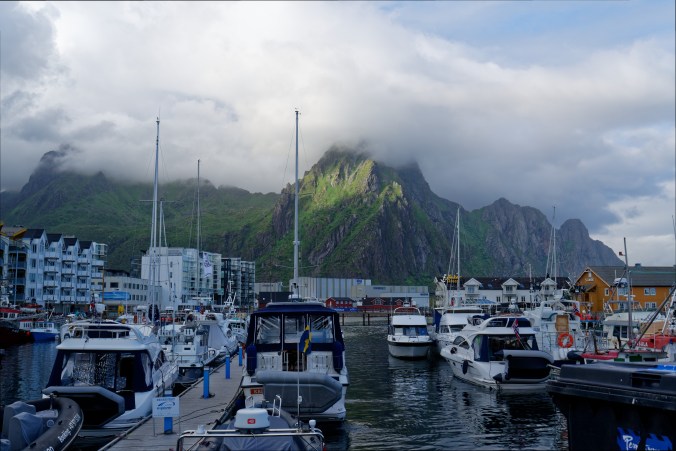 Evidence of human settlement stretches back 11,000 years. Since 800 CE men (that’s right, men; I know because of a photograph of Sunday worship in Lofoten Cathedral, ca. 1895) have migrated here in the winter and early spring, following the cod, who come to the area to spawn. One of the early Norse sagas tells of one Viking who sailed to England after a fishing expedition, and traded reams of dried fish for other essential goods. Whole, split dried fish hangs everywhere, even in the local equivalent of a 7/11.
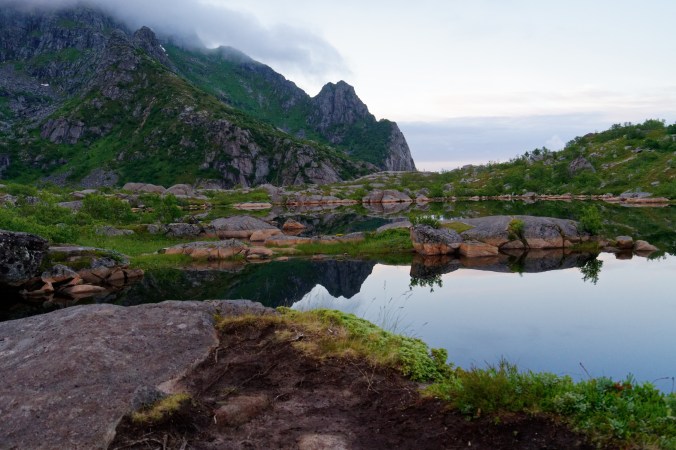 Dawn follows sunset within the space of half an hour: one moment, daylight is a golden red; the next, a cool morning blue. Astonishing. As if the world is birthing itself anew before your eyes; the diurnal cycle of hours unending, a joyful noise unto the interstices of time. And yet my mind rushes to imagine its biannual opposite: here, Nordspeople living in unremitting darkness for many winter months.
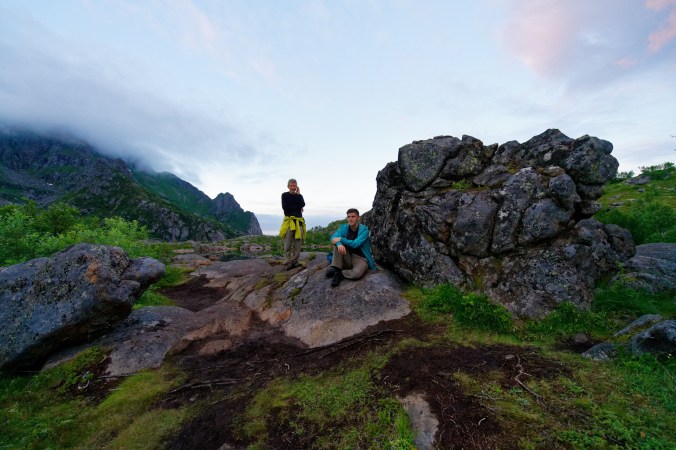 Last night, as we drove back to our Svolvaer flat at 1:30 am following a midnight hike in Henningsvaer in failed chase of a full view of the storied midnight sun (failed because, at the critical moment, we lacked the necessary northern sightlines), I noted that home after home in this town left a light illuminated indoors. They couldn’t get enough of it, even during the summer, I thought, perhaps a bit morbidly.
 Looking out a window: rays of sun shine between the mountaintop ridge and the fluffy cumulus. Walking the street from home to café beneath a looming cliff. Crisp air everywhere: it’s mid-July, and hovering around 50 degrees.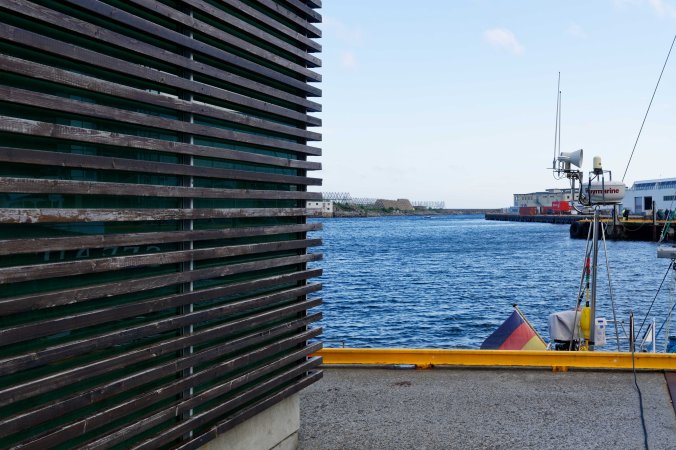
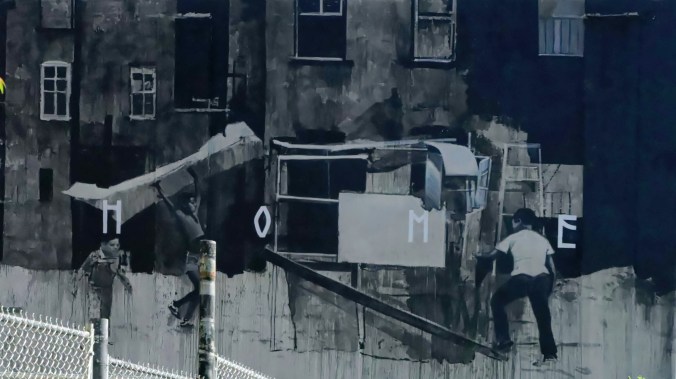 We’re traveling. To a lot of places, on six out of seven continents.
 The quotidian: we’re frantically trying to organize everything, financial, virtual, physical. Transfer responsibility for bills to a virtual bank. Prepay maintenance fees, due in January. Who’s going to shovel the sidewalk this winter? Water the plants? Will the vacation override from our health insurance come through in time to allow us to secure needed medications?

 Coordinating Goldhagens