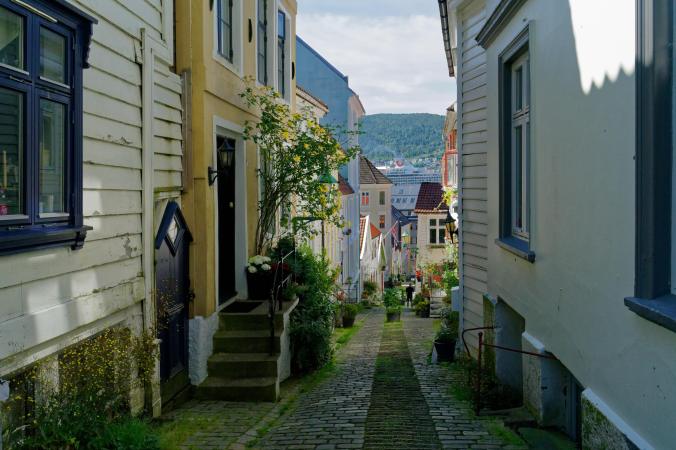
The Opening Arc

We’re on the KLM flight to Amsterdam, where in Schiphol we will rendezvous with Veronica. In sum, Norway has been a splendid beginning to our journey. A bit otherworldy in Lofoten; deeply affecting and unforgettable landscapes there, in the Sognafjord region, and on the drive onto Oslo; the opportunity to get our feet wet (wetter than we expected) as they, dry as can be, helped us scale, and scramble, and hike, and walk up and down slopes of unexpected difficulty and expected though still startling beauty;

DSC00399_DxO

cities and towns of a well-put-together country,

DSC00986_DxO

which, together with the universality of English, made our time negotiating a foreign land easy and stress-free; and two cities, though not spectacular, containing charm and enough urban offerings to occupy us engagingly for the short stays we allotted them. As a combination of highlights and ease, of newness and distinctiveness, Norway has been a sure winner as a place to start. Sarah and I have already accustomed ourselves to an existence of living abroad and underway. Gideon is a bit less settled, as the reality of a relatively kid-poor day-to-day requires adjustment. Yet spending so much time together, just together, in the countryside afforded bonded-us the time to bond even more in a right manner — an ubuntu-cultivating-practice which the Celtics pursued one year with a preseason stretch in Rome, setting themselves up for their successful championship run.

Norway is interesting (and fortunate) in other ways we should at least flag. Greatly owing to North Sea oil, as well as its people’s own human and social capital, it is among the world’s very wealthiest countries, producing a per capita income around twenty percent higher than the US and forty percent higher than Sweden. Yes, Sweden. This impressive wealth combines with broad income equality (its Gini coefficient is one of the lowest in the OECD), and enormous attention to public infrastructure, places, spaces, and goods. Rural areas and structures, notoriously poor around the world, are also sumptuous.

DSC00871_DxO

Roads (and gads of tunnels) are superbly designed and maintained. (We drove through the world’s longest car tunnel – 15.2 miles! – four times. We had not even known about it when we first came upon it in its rural area, and saw the sign announcing its 24 km. Imagine our momentary surprise.) Cars, in our two weeks of looking, are entirely dent and blemish free. Parks abound. Even the trees in the countryside have gotten on the program.

DSC00643_DxO

Materials used in the built environment are of immensely high quality, with textures that draw and excite the eye, mind, and body.

DSC00987_DxO

There is much to admire and consider about Norway, which even a cursory two-week visit such as ours should suggest to just about anyone, including and, especially during this era of mean politics and policymaking, to Americans.

After our mostly landscape oriented time in Norway, we have scheduled a couple of weeks of heavy-duty art, architecture, and urbanity in Netherlands and Belgium. This portion of our travels is not a change of pace insofar as these two countries also have extremely well-put-together societies (ignoring, Belgium’s schizophrenic ethnic composition and politics), yet it is a change of pace in the activities which will form the core of our stay.

We try to live focusing on the present, on the place we currently inhabit and the activity we undertake, maximizing the present’s potential. Nevertheless, on a journey which, in demanding so much planning, has compelled a great deal of forethought and prospective investigation, and, especially, with so many lustrous places ahead, it takes effort not to look down the road, especially, it seems, for Gideon when attaining and straining for a good vantage point directed at the geographically distant but temporally around-the-corner Serengeti.

DSC00797_DxO

–Danny, written July 29-30, posted in Amsterdam 1 August 2017

Graciousness, Public Space, Oslo

Gracious wins my vote as the word that best describes Oslo. The capital city of one of the world’s wealthiest countries, sidewalks are wide, cobblestoned paths and alleyways well-maintained, DSC01053_DxO

and its abundant public spaces carefully, thoughtfully designed.

DSC01100_DxO

Parks are everywhere, although for overall greenness, several studies, including this– (https://www.siemens.com/entry/cc/features/greencityindex_international/all/en/pdf/report_en.pdf) — indicate that Copenhagen and Stockholm surpass Oslo, though not by much.

DSC01045_DxOIn many open areas and public spaces, art installations are carefully installed, including this one, which combines a phone charging area and seating. The public art varies widely in quality, at least it’s there.
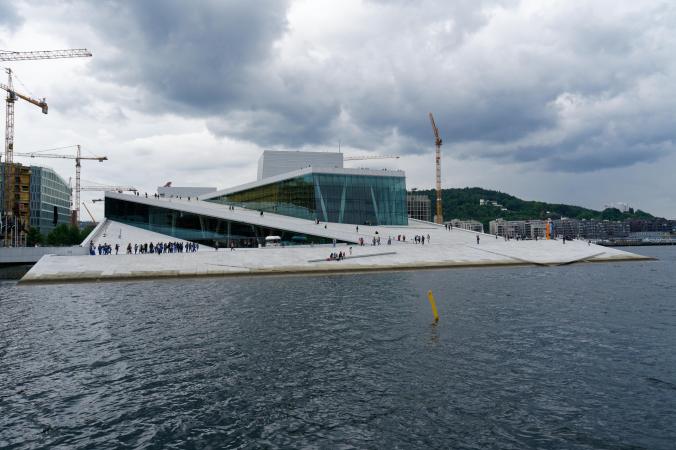
Anker Brygge, the newly developed waterfront area, looks out across water onto Snøhetta’s Opera House and Ballet Theater, which is as good as its press indicates.

DSC01077_DxO_DxONot a great building, but an excellent one. (Few projects of any sort, artistic, architectural, or literary, rise to the level of great.) All over Anker Brygge, new, new new:
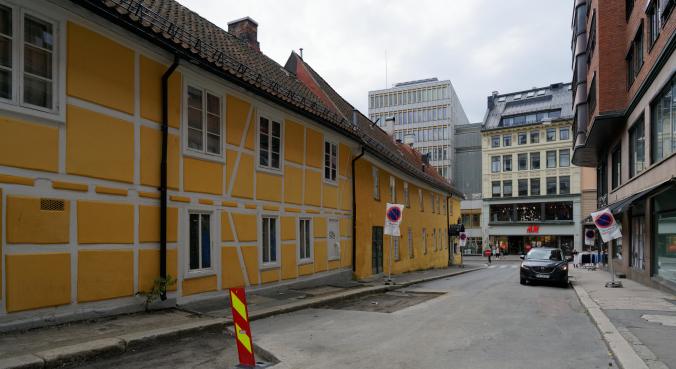
DSC01097_DxO

Renzo Piano’s Astrup Fearnley Museum bridges the end of a long boardwalk which, at its opposite end, is edged by a few older warehouse and storage buildings, meticulously renovated, along with many newer mid-rise commercial and residential buildings.

DSC01059_DxO

This time it was Danny, not I, who fantasized about spending some time every year in a place we’ve traveled to see. More commonly I am the one who pokes around the nicer places we encounter– Marbella, Spain; The Sea Ranch in northern California; the Lakes District in England — all have received their due consideration, all for naught. Here the reverie evaporated rapidly: real estate agencies advertise both new and older residential properties at staggering prices: $2.3 million for a 500-square-foot studio apartment.

In the older part of the city, my favorite place became the Oslo Cathedral and environs.

DSC01061_DxO

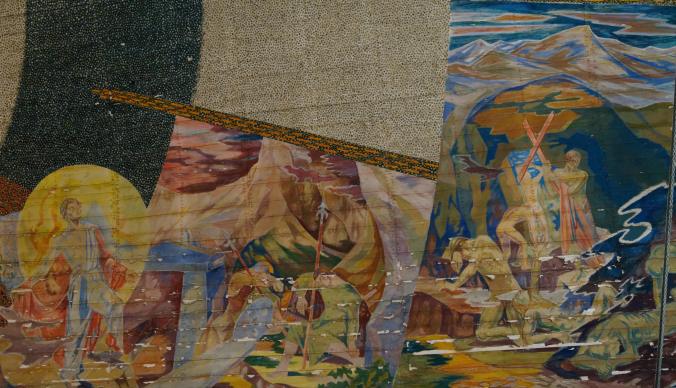
The Cathedral is the most spacious 17th-century central plan church I’ve seen, and has a barrel-vaulted ceiling decorated with murals painted in the 1950’s narrating the life of Jesus – each episode carefully drawn in a Norwegian landscape.

DSC01066_DxO

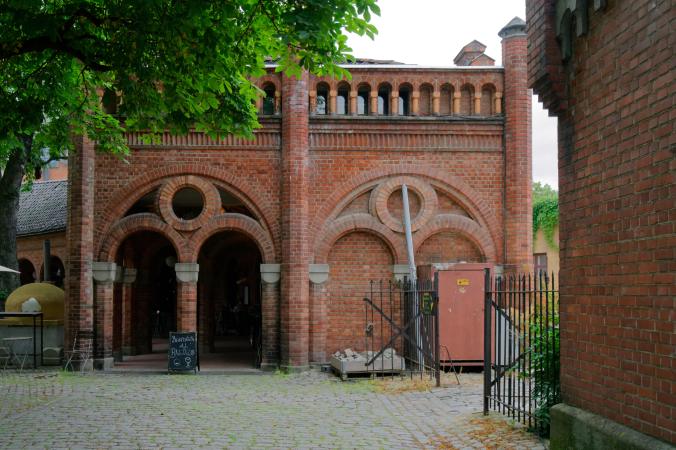
To one side of the cathedral sits the Basarhallene, an arcaded brick neo-Romanesque courtyard built in the mid-19th century to house butcher shops. Even it is graciously arranged and beautifully detailed.

DSC01072_DxO

In our walking, walking, walking, we also ran into the old copper-banded, round-cornered modern commercial building (ca. 1960) that I recalled seeing when I exited the Oslo train station in 1975, forty-two years ago. Hadn’t thought of it once since that day, and my recollection of it was pristine, clear, as if it was only days when I’d walked by it last. Unbelievable how place-based our long-term autobiographical memory really is: Just a glimpse snapped it in place.

Decided not to shoot.

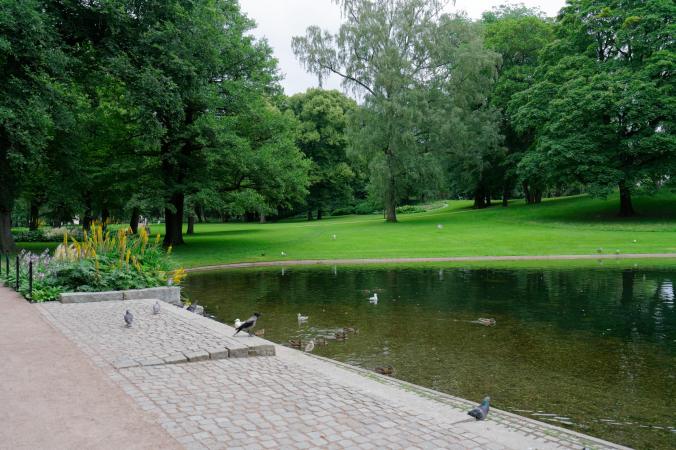
Then in our perambulations around the city, we skirted the park in which I found a bench and, exhausted from a crowded, overnight train ride here, slept for several hours in the early morning sun. Later, Danny showed Gideon and me the exact spot where he lay down, at age 20, on the grass under a tree and also slept (pictured above). Gracious, peaceful. That is the experience of Oslo.

Accompanying me throughout Norway was Karl Ove Knausgård. I had read the first volume of My Struggle several years ago, and was impressed by Knausgård’s intelligence while at the same time I recoiled from his nihilism (“what was man on this earth other than an insect among other insects”), and endless self-examination. A couple of days before we boarded the plane bound for Norway, I decided it was time to give Volume Two a try. (In total, there are six, each between four and six hundred pages.) Better than One, Two narrates an account of his leaving his second wife in Norway and moving, somewhat impulsively, to “that shitty little country”, Sweden. There, he reconnects with Linda, a poet and dramatist five years his junior and falls in love with her tender, wounded soul; they become a couple, and Knausgård subsequently settles, uneasily, into a husband’s and father’s life.

As ever, Knausgård remains tortured.

Everyday life, with its duties and routines, was something that I endured, not a thing I enjoyed, nor something that was meaningful or that made me happy. This had nothing to do with a lack of desire to wash floors or change diapers but rather with something more fundamental: the life around me was not meaningful. I always longed to be away from it.

Yet each each successive account of his turbulent ruminations is recounted in such a soulful, authentic way that reading the book necessitates a depth of emotional involvement that is rare, even in the best literature.  And his descriptions of life’s joyful moments absolutely soar. Some have called Knausgård a contemporary Proust, with all the insight and none of the lace: few metaphors; blunt, declarative sentences; exacting descriptions of life’s daily activities. An account of washing the dishes after supper or a trip to the supermarket can run five or ten pages; somehow, it just doesn’t become flat or dull. Curiosity compelled me to read on – did this account of Linda’s sour mood and petulant conduct (both of which seems to Knausgård’s specialize in) — portend an incipient crisis, or was it just another thing that happened in the course of that one day? As James Wood wrote in his review of the book’s first two (400-600-page) volumes, even when I was bored I was interested.

And his fond accounts of Norwegian cities, landscape and culture rang true, over and over again.

DSC01096_DxO

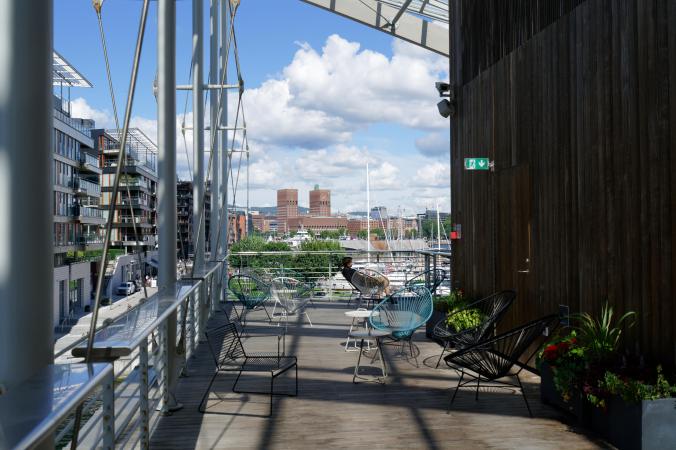
This is the Radhus, (City Hall) seen from the terrace of Piano’s Museum.

— Sarah, 30 July 2017, posted in Amsterdam, written on our last day in Oslo

Lovely Goes Only So Far

Weather so governs a trip such as this.  We planned the trip to sidestep the cold, Norway in July, Tierra del Fuego the day after New Year’s. Heat is impossible to avoid. Rain is both probabilistically foreseeable and haphazard. 20 days a month (the mean also for July) in Bergen (said to be 25 by our exaggerating host), 15 days in July on Lofoton, yet we’ve had brilliant sun (mixed in with a bit of rain and clouds on Lofoton). Ordinarily, I shirk from discussing or even exulting or lamenting the weather, that verbal social elixir par excellence and topic of apparent genuine interest and concern for legions of people (whose livelihoods don’t depend on it, such as farmers and snowplow operators). With minimal clothing, we managed to survive well enough what should be the coldest temperature (or, rather, real-feel) of this leg of the trip, the fifty degrees and cold ocean wind of Lofoton.

Bergen is a startlingly beautiful small city of 250,000, made so by its urban planning and design and its vernacular architecture and touches, such as flowers, rather than by great or monumental buildings or squares. DSC00519_DxOGrace, scale, detail, and color all contribute to the built environmental nobility which Bergen confers on its every inhabitant, permanent or itinerant. DSC00489After the small human footprints on the experientially vast landscape of Lofoton, Bergen probably appears even more robust an installation of civilization than it is.
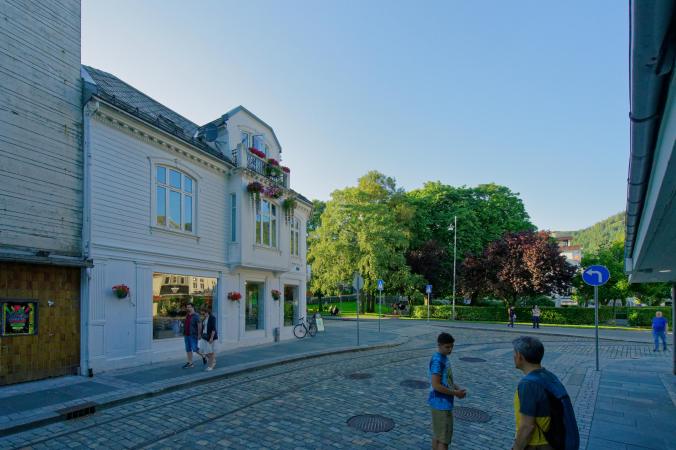
For us, Bergen invites walking and walking, and not the usual visits to sites of note or interest. DSC00501_DxOEach cobblestoned-step holds attention.DSC00541_DxO Each house, or at least many, invites inspection, offering some reward in form, surface, or color, which is deployed without hesitation yet with a sense of composition and palatal restraint. DSC00511_DxOIt is also bustling, because the day and a half we are there are the warmest (mid seventy) and sunniest, so we are told by several people, yet of the summer.
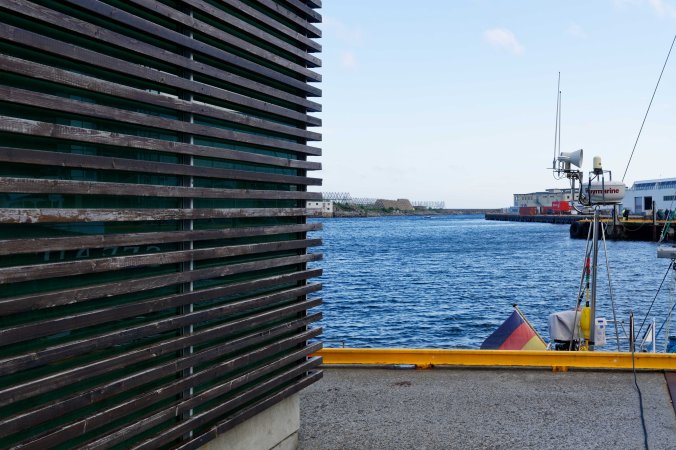
We wanted to see a city in Norway other than Oslo, and thought that Bergen, Norway’s second city, offered the most. Lovely it is. Yet a day and a half was just right, as the flip-side to its small and non-marqueed profile is that the sights and arts institutions don’t attract us, particularly as the artistic and architectural glories of (Oslo and) the Low Countries beckon around the corner.

— Danny, 24 July 2017


East Harlem is home, but for the next year . . .

DSC00265_DxO-2_DxO-2_DxOWe’re traveling. To a lot of places, on six out of seven continents.

The itinerary? First question everyone asks. We’ll let it unfold for you in real time, as it will for us — unless one of my two coauthors decides otherwise. Such is the nature of family coordination, which does indeed happen — not always in perfect harmony — and which characterizes both the essence of this blog and the inevitability of our journey.

This week, we’re adjusting to the reality that that jet plane takes off , with us in it, in six days. Ready or not! What’s occupying our minds — or at least mine — are things quotidian and existential.

20161030_195838The quotidian: we’re frantically trying to organize everything, financial, virtual, physical. Transfer responsibility for bills to a virtual bank. Prepay maintenance fees, due in January. Who’s going to shovel the sidewalk this winter? Water the plants? Will the vacation override from our health insurance come through in time to allow us to secure needed medications?
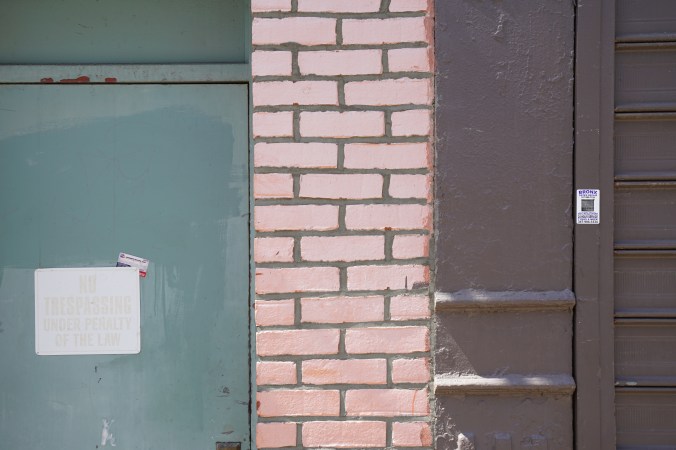
And: Cleaning out shelf space; tossing expired prescriptions and never-opened mouthwash from bathroom cabinets; jamming brick-like, window-sized vacuum-sealed bags stuffed with decades of clothing under the bed. Our home’s temporary residents need space too! Finishing reading other people’s manuscripts: friends’ novels, screenplays, an estate plan.

The existential: all this planning and arranging — planning the trip, arranging what will happen here when we’re gone —  impresses upon me (again) the intricate, but not at all fragile web of friendships and everyday decisions that ordinarily steadies an ordinary life.

That web steadies also me. Friends visit over dinner, but as to decisions, they stream without end: How to get rid of those wretched plastic bags from Key Goods, which are so dreadful for the environment? How to set the (needlessly complicated) thermostat? How to get rid of the ants in our plants? Over hours and days, decisions were made: by me, by Danny, by Danny and me together, by Danny and me in conference with Gideon and/or his elder sister, Veronica.DSC00107_DxO

East Harlem has been home for only four years. Yet I’ve discovered fragile shoots growing from the soles of my feet; thin, tapering roots, and they are ripping, slowly ripping out, covered in the dirt of East Harlem’s vacant lots, the dust of corner bodegas, haunted by the specter of threatening tattoo parlor signs, murals like the “HOME” one on Second Avenue around 101st Street.

Here are photographs of the neighborhood, things I’ve noticed about where we live, before we go.

Harlem colors

Harlem colors.2_DxO-2


Until soon, bye — Sarah, July 9th, 2017

DSC00217_DxO