Since I am both the designated and self-designated photographer of this lengthy adventure, I have, over the past few months, devoted a good deal of energy learning about the possibilities of, and the skills necessary for photographing in a now-dominated-by-digital world. My last camera, a sturdy single-lens reflex Canon E05, was stolen last year. Humiliated by my inadvertent agency in its disappearance (I’d carefully packed it in my handy durable neon orange suitcase; the airline baggage carriers in Bilbao “lost” the bag), I’d not yet purchased a replacement.
We started with a pilgrimage to B&H Photo on 34th and 9th. Danny had never been, and found amusement in its cornucopia of imaging gadgets, from film projectors to televisions to drones on which to load a camera so you can shoot aerial images with a remote; most stations are tended to by kindly, immensely knowledgeable Orthodox Jews. We decided upon the head-spinningly smart new mirrorless Sony (mirrorless means less weight, a good thing when on the road), which captures “full-frame” images as data-dense as anyone, professional or amateur, could possibly need. In one image, tiniest details in dark dark shadows appear alongside bright white sunny skies – a big boon when shooting architecture, and life. The improbably-named Christopher, our lens salesperson, also introduced me to an image processing program (not Photoshop) which corrects for perspectival distortion, along with offering a raft of other possible, more radical edits – turn that red room green! Transform daylight into night! – in which I have no interest, and for which I have no need.
Along with learning, thinking. Thinking, thinking, wondering what a photograph is for. About the divergence of its meanings for its viewers and its maker. About its distortions, lies, and omissions (which I’ve written about, most recently in Welcome to Your World). And thinking also through that long-settled debate, namely, can a photograph rise to the level of fine art? Or should we ghettoize even artsy photographs (Gernd and Hilla Becher, for example) as little more than prettied-up documentation? Most would consider these questions anachronistic, but they remain salient for me for two reasons: because of how I choose my subjects, and because my beloved Danny believes that photographs, even staged ones such as those by Cindy Sherman or Gregory Crewdson, rarely rise to the level of art.
Photography has been woven into my life since high school, even more so since college, because the subjects of my writing demand as much. Can’t mean without them. Yet you must always write as though the photograph wouldn’t exist, because a writer exacts little to no control over what images will or won’t get published. (Begging helps a little. Money helps a little more.)
Like anyone carrying a camera, I leave countless moments and images behind. In my case, many of these foregone possibilities are ones that any good travel photographer would snap, often for documentary purposes. Here’s what the Brygge in Bergen looks like. The Queen Mary II, docked beside it. Danny here! Gideon there!
No. Take the seagull that figured in my first Lofoten Islands entry: I considered shooting it, but then demurred, thinking that photographs so distort scale that my picture would likely fail to illustrate my observation about the immense size of Nordic gulls in comparison with East Coast ones.
Usually I am trying to get people out of my pictures. In Norway even more so. Why? These mountains and fjords and waterfalls loom over us, and over time; they’ve remained steadfast through centuries. People? They come, then they go.

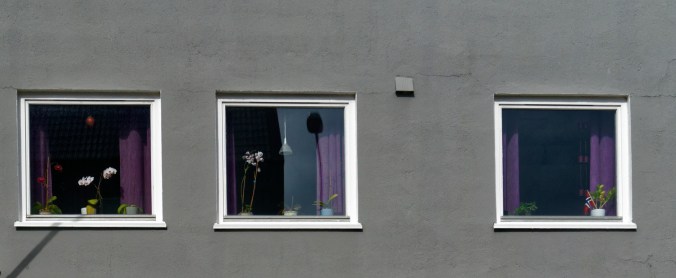
Life lived behind a viewfinder becomes a life slowed down. I’m often imagining frames around moments, constantly on the hunt for the right composition. (That’s the only way that the otherwise-too-violent nomenclature of “shooting” a picture makes sense.) What, then, constitutes my right composition? For now: the horizon line must must must be perpendicular to the vertical edge of the frame. Repetitive patterns of one type (wood slats) abutting patterns of another type (rock slabs) are ever-alluring. Colors: white orchids and purple curtains in tiny gray windows;
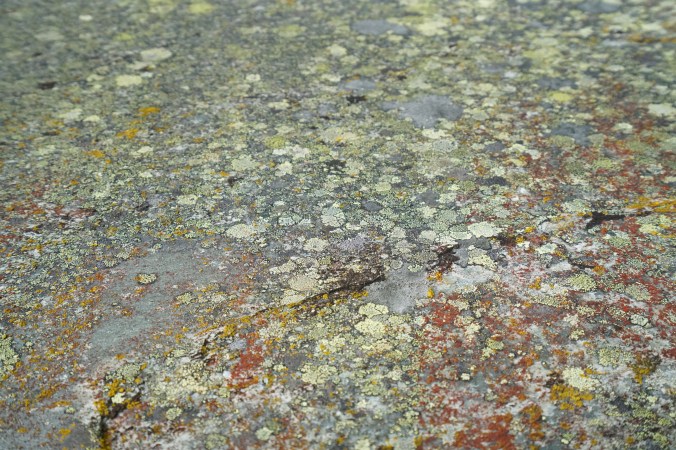
black, rust, and thin green lichen on rocks;
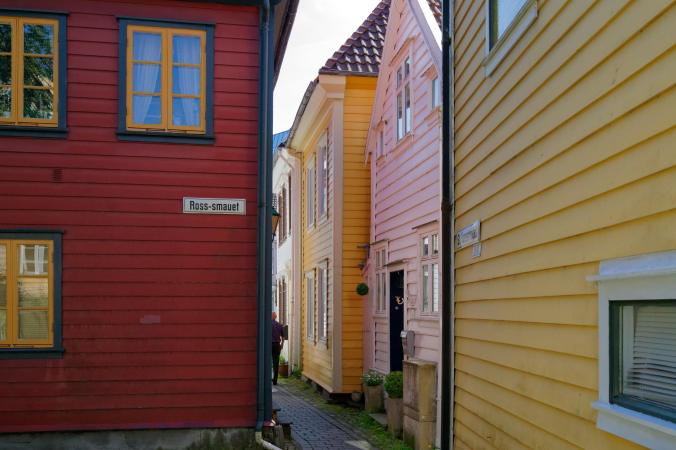
deeply saturated ochre, barn-red, and pink paint on buildings;
 clouds and sky at different times of day. In landscapes, I’ve been gravitating toward imbalanced compositions – one side in deep shadow, the other suffused with rosy hues.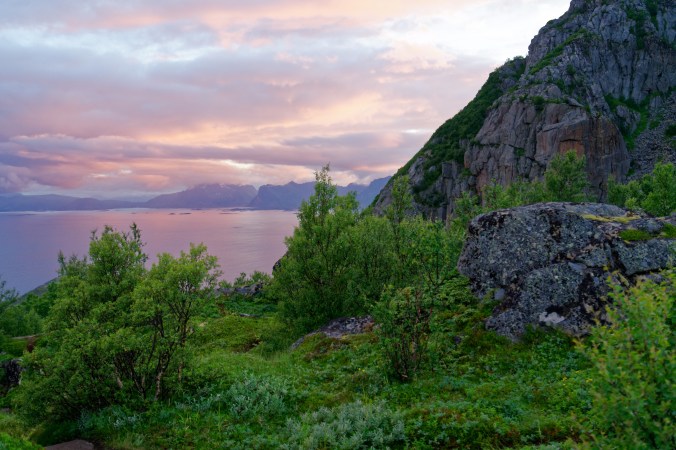
Photographing buildings, my predilection for symmetry surprises me, but it’s not always possible.
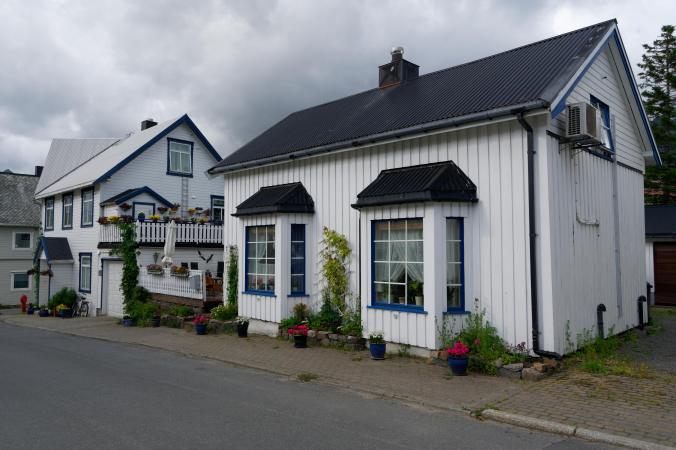
And always, I wait for the late afternoons, with their strong, warm light, full of contrasts and ethereal promise.
In taking a photograph, I often wonder, am I creating a memory or preserving it? Both, I suppose. And if the former, then what kind of memory? Maybe even false memories. I’m entertaining the possibility of basking in the ignorance of presuming that Joẑef Plečnik built a nice little cinema in Bergen, rather than doing the right thing (research) to actually find out.

In the spring of 1991 in Dhaka, Bangladesh, I stood on the banks of the Brahmaputra River regarding the hand-hewn wooden boats, the late afternoon sun glinting off rippled water, the men in their lungis hauling nets of fish onto the docks, and I thought: this is beautiful, and real. I reached for the camera hanging around my neck, looked into the viewfinder, and realized that the picture I was about to shoot couldn’t possibly capture the experience of standing there. For one reason if not for many: stench. Accompanying the visual enticements was the stench of dead fish, the stench feces — human, animal, whatever; the stench of rotting organic manner washed up on the riverbanks. What this picture will show, I mused, is visual beauty; what it will hide is noxious acridity.
Shot anyway. It’s a picture I treasure.
— Sarah, 25 July 2017

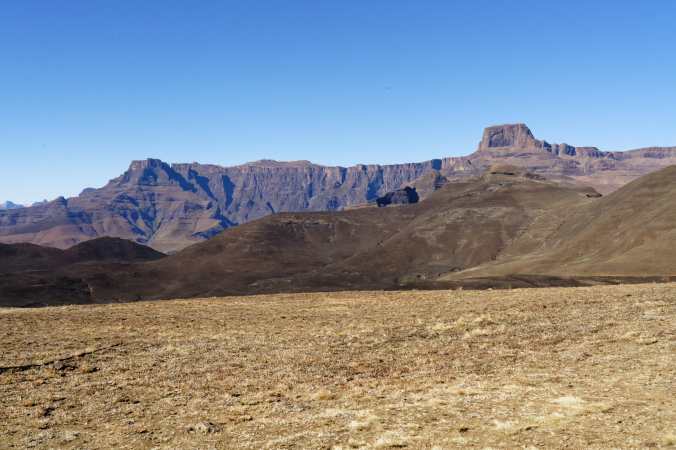


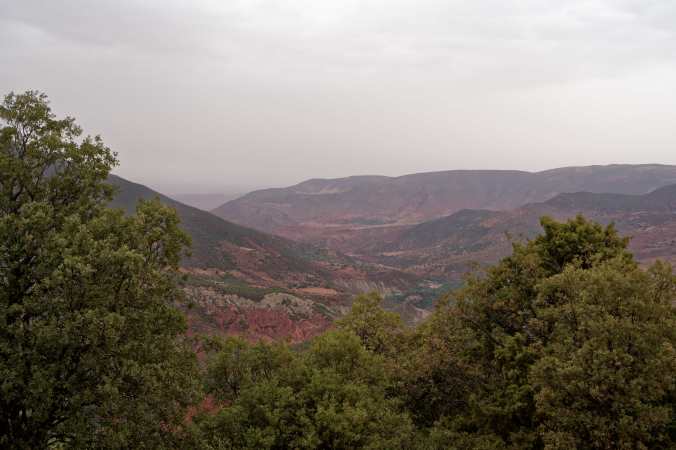
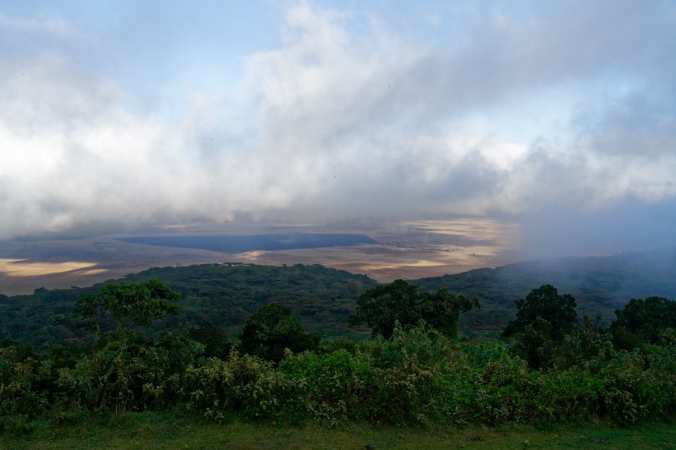

 Sarah and I set out on our adventure with the purpose of writing books, one by her and one by me, very different in character, each possible only through this long journey. More on them in a moment. We also set out committed to the writerly experiment of this let-the-spirit-move-us collaborative blog, which includes Gideon, who, I hope, will make his entry here soon and thereafter frequently. For Sarah and for me (about Gideon, who also has other writing projects, I’m not sure), the question of what goes where is live, and, at least for me, has not been resolved clearly.
  Roughly speaking, my schema is to offer you accounts and observations about the world out there which we encounter on our carefully chosen itinerary of barely scratching the world’s surface, even with a year of scratching at our disposal. The inner workings and inter-workings of the three of us – what it is like to travel with two loved ones for a year, and how the many and ongoing encounters with one another and with the offerings and demands of the world we will wend our way through affect and change us as individuals and in our relationships as parents and child, as married people, as individuals positioned differently in the ever-changing arrays of living – these things about us are the stuff and soul of the book. The rub might be obvious: the line, actually lines demarcating what’s out there from what’s in here (the family circle and each of our minds and hearts) is hard to draw, especially as the inside is implicated in the outside, most essentially because both constitute and are filtered through experience, thought, and language. (Taking and posting photos – Sarah’s and Gideon’s domains – are more clear cut.) So, deciding what’s in and out of the blog, because what constitutes the in(side) and the out(side) of the respective worlds we are living and seeking to understand is often indeterminate, is an ongoing and inherently messy and probably shifting process which I am negotiating with that very tough and a bit ambivalent negotiator, myself. As to the other negotiator involved here, I think less beset by this manner of thinking, I’ll leave it to her to engage her blog/book issues herself.
 Lofoton, above the Arctic Circle in midnight summertime sun Norway, was a spectacular place to begin our journey. The breath-taking and -giving monumental landscapes, which can be imaginatively discerned well enough through the miniaturized photos (which I expect Sarah will happily insert), as a undulating symphony of approachable mountains and hills, and lakes and fjords. We drove for hours through it at nearly every hour of the 24-hour day, including 1 in the morning, 5 in the morning, 9 in the evening, 11 in the evening and the more conventional sightseeing times in-between. Riveted and scanning, still and pointing, quiet and in full conversation (see shadows above), we drove, we walked, we looked, we breathed, we experienced Lofoton. For two days our ordinary rhythms of sleeping and waking, eating and… we cast asunder. We walked (see Gideon, double above), we hiked (straight up a small mountain nearing midnight), we drank coffee outdoors in the just warm enough weather, as we lived according to our own time- and activity-wants. We valiantly twice tried to see the sun at solar midnight descend, bounce, and rise slightly above the horizon, and failed for differently reasons. The attempts felt (in our exaggerating subjectivity) near-heroic, so we, the reasonable agents we are, felt disappointed yet satisfied that we had done our best. And so, we have yet another reason to return to Lofoton, to find and follow the midnight sun.
 Coordinating Goldhagens